The season’s winding down, and if you’re like most of the athletes I coach, you’re ready for a break. Take it. You earned it.
Here’s where it goes wrong: walking away completely for four, six, eight weeks. Cold turkey feels like rest. It isn’t free. A 2022 study in the European Journal of Sport Science found meaningful drops in cardiorespiratory and muscular fitness in endurance athletes after just two weeks of complete training cessation — not months, weeks. What you built over a season doesn’t survive an off switch.
The other extreme is just as bad. Staying locked into structured, race-specific training all winter means you show up to next season’s build already worn down, with nothing left to spend.
The off-season isn’t “no training.” It’s different training, aimed at four things:
1. Recovery. Actual recovery, not a lighter version of the same plan. Reduced volume, more sleep, less structure, permission to miss a day without it meaning anything. This is what lets the fitness you built all season actually consolidate, instead of just holding on by a thread. But that window has an edge — the detraining research above is the reason “a few weeks” and “a few months” are not the same thing.
2. Strength. Real gym work, aimed at what 2027 is going to ask of you: durability, power, resilience to injury. A well-known study in Medicine & Science in Sports & Exercise had distance runners add heavy, low-rep strength work (think near-max half-squats) alongside their normal training for eight weeks. Running economy improved by roughly 5%, with no drop in VO2max and no added bulk. That’s a real edge, and the off-season, when you’re not trying to run fast on tired legs, is the best window to build it.
3. Base. Easy aerobic volume, no structure, no pressure. Just time on feet, on the bike, in the water, keeping the engine warm. Research on elite endurance athletes across sports, running, cycling, rowing, cross-country skiing, consistently shows they spend somewhere around 80% of their training time at low, conversational effort and only about 20% at moderate-to-hard. The off-season is where that low-end base gets built without a race pulling you into the red to do it.
4. Technique and weaknesses. This is the one nobody wants to do and everyone benefits from. The stuff you’ve worked around all season: the hip that never quite fires, the catch in your swim stroke, the pacing discipline that falls apart late in a race. Research comparing runners of similar fitness has found that a real chunk of the difference in running economy comes down to technique, not just physiology. Off-season is the only time you can slow down enough to actually fix something and let it become automatic, before race pace asks you to hold it under fatigue.
That’s the plan for the next several weeks: not maintaining what you did this year, but building the foundation for 2027.
Which is where I want to hear from you. Everyone’s 2027 goals look different: a first ultra, a faster century, getting back to racing after time off, or just building a body that can keep saying yes to adventure. Your off-season should be built around your specific goal, not a generic template.
If you want to map out what that actually looks like for you — strength split, recovery windows, base volume, and the technique work worth fixing now, send me a note or grab time on my calendar here: Contact Me
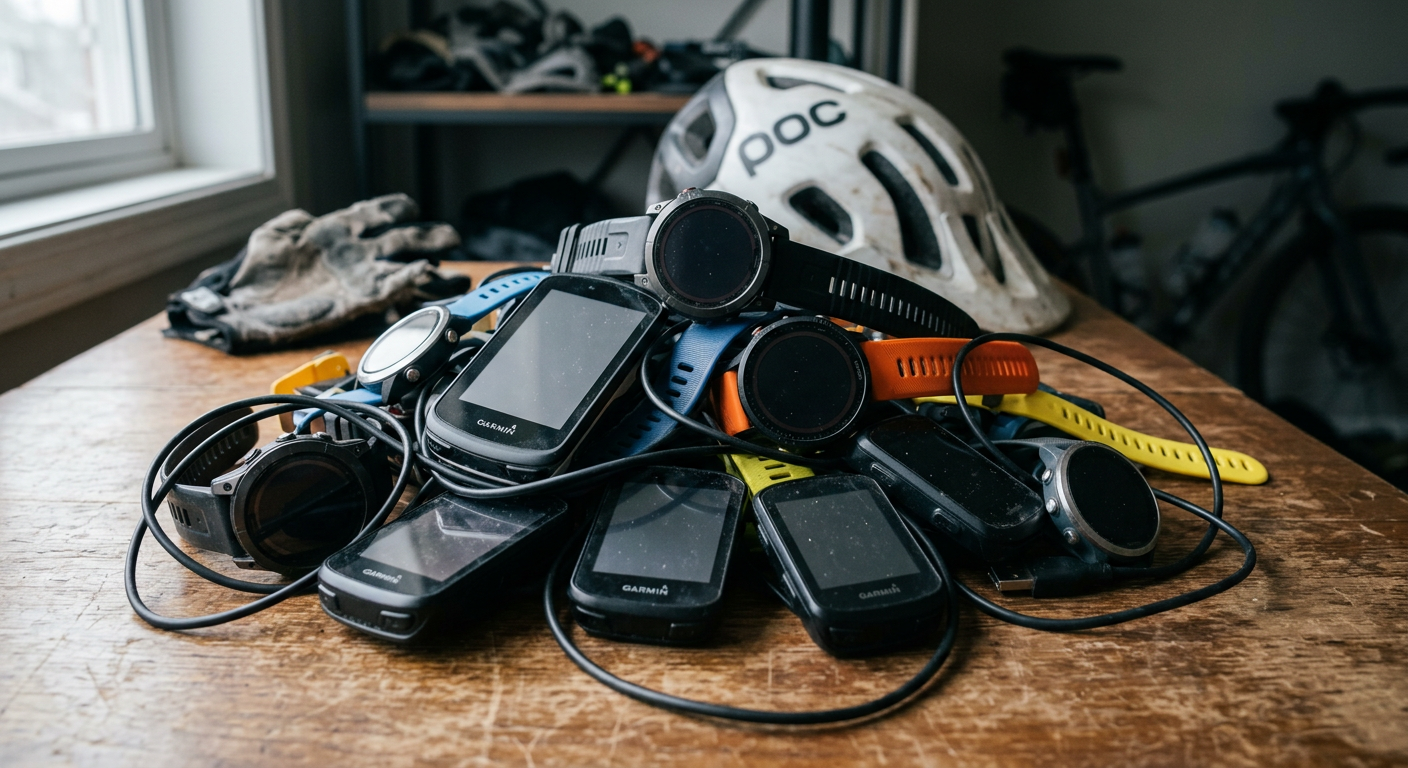
A few weeks ago I watched an athlete’s heart rate climb ten beats per minute on a climb she’d run a dozen times before, at a pace that felt, in her words, “exactly the same as always.” Her watch said she was working harder. Her legs said otherwise. Her watch was wrong.
That gap — between what your metrics say and what your body is actually telling you — is the whole reason I build every training plan around Rate of Perceived Exertion first, and heart rate, power, and pace second.
Not instead of them. Alongside them. But in the right order, because each of these tools is only honest under certain conditions, and none of them was built to run the whole show.
Heart rate: honest in the lab, unreliable everywhere else
Heart rate zone training came out of controlled lab tests in the 1970s and 80s — steady conditions, steady temperature, steady terrain. It’s a great tool in that exact environment. The problem is that almost none of you train in that environment.
Your heart rate isn’t just responding to your pace. It’s responding to your total stress load — and that includes things that have nothing to do with fitness:
Heat. Your body diverts blood to your skin to cool you off, so your heart rate climbs at the same pace and same effort, just because it’s 85°F instead of 60°F.
Elevation. Above about 5,000 feet, there’s less oxygen pressure in the air, so your heart works harder for the same output — before you’ve done anything differently.
Hydration and caffeine. Both push heart rate up independent of effort.
Cardiac drift. On a long ride or run, your heart rate climbs over time even when your effort hasn’t changed — partly rising core temperature, partly accumulating fatigue. If you chase a fixed heart rate number on a long day, cardiac drift will quietly talk you into slowing down when you don’t actually need to.
Fatigue, going the other direction. A genuinely tired athlete’s heart rate response gets blunted — it climbs more slowly and tops out lower, which can trick you into thinking you’re not working hard when you’re actually cooked.
None of that means heart rate is useless. Your resting heart rate and your recovery heart rate — measured the same way, under similar conditions — are genuinely useful signals for how well you’re absorbing training. I still have athletes track both. I just don’t build a workout around hitting a heart rate number when the conditions that day make that number meaningless.
Power: excellent on a bike, still catching up everywhere else
This is where discipline matters most, so let me be direct instead of vague: if you’re on the bike, your power meter is one of the best tools available, full stop. Cycling is a closed mechanical system — the road or trainer doesn’t change shape under you the way trail does. A watt is a watt whether you’re fresh or fried, uphill or down, once you account for grade. I use power on the bike constantly, especially for structured intervals and pacing long rides.
Running power is a different story — not because the idea is bad, but because the technology isn’t there yet. Running power meters don’t actually measure force directly; they estimate it from your motion and back-calculate what it would take to produce that speed. That estimate holds up fine on a flat road or a familiar loop of consistent trail. It falls apart the moment the surface changes — pavement to sand, hardpack to loose scree, a technical descent versus a smooth fire road. For anyone training across mixed or technical terrain, which is most of you, running power is a data point to note, not a number to chase.
And in the water — there’s no meaningful power metric at all. Feel is genuinely the only real-time tool you have.
Pace: only honest on a track
Pace tells you what you did. It doesn’t tell you how hard it was to do it. A 9-minute mile on fresh legs, flat pavement, cool morning air is not the same event as a 9-minute mile at hour six of a long trail day, climbing, in the heat. Same number on your watch, completely different physiological reality.
Pace is still worth tracking — it’s how you measure progress over time on comparable terrain, and it’s useful for pacing strategy on a course you know well. But treated as the primary intensity signal, it actively misleads you the second the terrain, weather, or fatigue level changes. Which, if you’re training for adventure instead of a treadmill, is most of the time.
RPE: the only tool that’s actually watching all of it at once
Rate of Perceived Exertion is nothing fancier than a 1–10 scale of how hard something feels, developed by a Swedish researcher named Gunnar Borg back in the 1960s. It sounds almost too simple to trust. Here’s why it works better than it sounds like it should: it’s the only measurement that integrates cardiovascular strain, muscular fatigue, and whatever the day itself is throwing at you — heat, altitude, bad sleep, a stressful week at work — into a single real-time number. Heart rate, power, and pace each capture a slice of that picture. RPE captures the whole thing, because it’s coming from the one sensor that’s actually experiencing everything at once: you.
The catch is that RPE is subjective — my 6 might be your 8. That’s exactly why I don’t just hand an athlete a scale and hope for the best. I calibrate it, using something borrowed straight from exercise science called the Talk Test:
Comfortable — you can talk in full sentences without effort. That’s roughly RPE 1–4.
Labored — you can still talk, but only a sentence at a time before you need to catch your breath. That’s your threshold zone, RPE 5–7.
Uncomfortable — you can barely speak at all. RPE 8–10.
Do that a few times across different efforts and I have a real, personal read on how you interpret hard — not a generic chart that assumes everyone feels intensity the same way.
How this actually shows up in your training plan
In practice, it looks like this:
On the bike — power is my primary number for structured work, RPE confirms it still feels right on the day.
On technical trail, in heat, or at altitude — RPE leads, heart rate is a secondary note, pace is context, not a target.
In the water — RPE, essentially by default. There’s nothing else reliable to lean on. But coach, you chased the clock for decades in the pool. Yes I did. But we’re endurance athletes, we’re not chasing hundredths of a second here, we’re chasing hours. I’m not knocking master’s swim programs, they’re great. But we’re not training for a 200 fly at master’s nationals.
On race day, especially anything with real climbing — I build pacing strategy RPE-first: figure out the effort you can sustain on the hardest climb, then hold everything else one to two points below that. That’s a more honest pacing plan than a flat heart rate or pace target that falls apart the moment the course tilts uphill.
None of this means throw away your devices. It means using them for what they’re actually good at, and not asking a heart rate monitor to do a job it was never built for. Data should inform your training. It shouldn’t be the verdict on how your day went — your body already knows that, if you’re paying attention to it.
Want help building a training plan that actually reads your effort instead of arguing with your watch?
Hit reply and tell me what you’re training for — or if you’re on Instagram, DM me RPE and I’ll walk you through exactly how I’d calibrate it for you.
There is a version of endurance training that looks great on paper.
Every workout completed. Every interval hit. Every long session done exactly as written. No interruptions. No fatigue. No schedule conflicts. No life.
And for most adventure-driven athletes, that version does not exist.
Good.
Because the athletes I work with are not trying to build fitness in a vacuum. They are building it inside full lives. Careers. Families. Travel. Stress. Weather. Limited time. Shifting energy. Real responsibilities.
That does not make you inconsistent. That makes you human.
The problem is that too many athletes still judge themselves by a standard that was never built for the life they actually live. They miss one workout, shift a long ride, shorten a run, or swap a session because their body or schedule says something different than the plan.
And then the spiral starts.
They feel behind. They feel like they are losing momentum. They start questioning the whole week. Sometimes they stop trusting themselves altogether.
But missed perfection is not missed progress.
Fitness is not built because one Tuesday workout was flawless. It is built through the steady accumulation of work over time. The big picture matters more than the isolated blips. One adjusted workout does not ruin your season. One messy week does not erase your base. One pivot does not mean you lack discipline.
In fact, for many athletes, learning how to adjust well is one of the most important skills they can build.
That is what imperfect training really is.
It is not laziness. It is not softness. It is not lowering the bar.
It is knowing how to stay pointed in the right direction even when the week does not go to plan.
Sometimes imperfect training means shortening the workout and still showing up. Sometimes it means moving the key session and letting the rest go. Sometimes it means taking the easy day easier than your ego wants. Sometimes it means getting outside for two hours instead of forcing the exact numbers indoors. Sometimes it means understanding that the best session for today is the one your life can actually support.
That is not failure. That is maturity.
Adventure-driven endurance athletes need a different standard.
Not “Did I execute every detail perfectly?” But: Did I keep moving forward? Did I make a smart decision? Did I protect the rhythm of training inside real life?
Because that rhythm is what keeps you in the game.
The goal is not to become the athlete who never has disruption. The goal is to become the athlete who knows how to navigate it.
That is where coaching actually matters.
Not in building some fantasy version of your life where nothing ever shifts. But in helping you remove decision fatigue, adapt without guilt, and keep training in a way that supports both performance and the rest of your life.
You do not need more pressure. You do not need a plan that punishes you for being busy. You do not need to earn progress by executing perfectly.
You need a framework that works in the life you actually have.
That is the case for imperfect training.
Not less commitment. Not less intention. Just a better way to stay in motion.
Have you ever come across that meme featuring Kobe Bryant’s 10 rules for success? It seems to pop up in my social media feeds just when I need a dose of inspiration. Kobe, a legendary figure in basketball, was not only an athlete but also … Continue reading Unlock Greatness: Kobe Bryant’s 10 Rules for Achieving Success
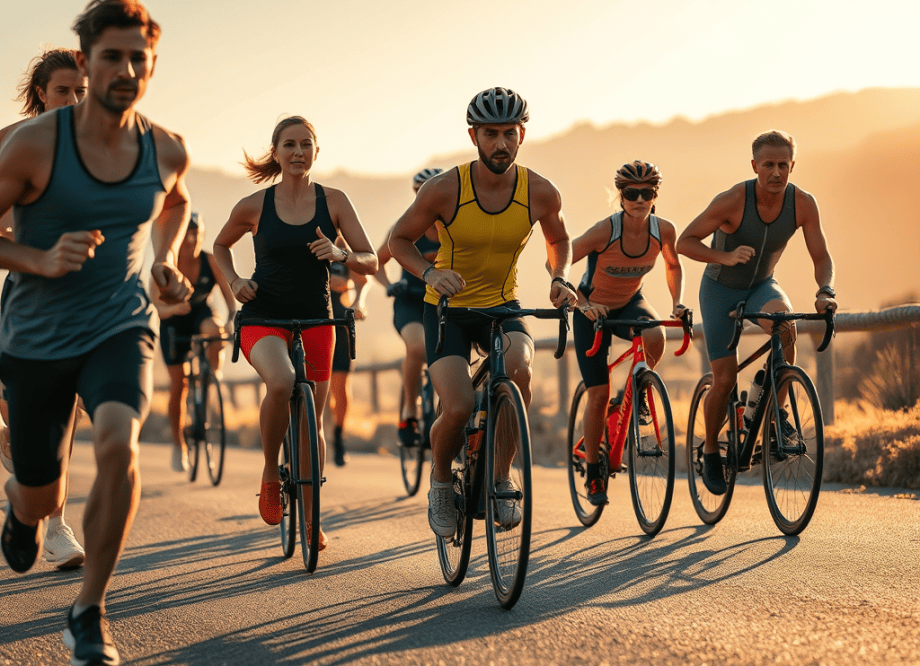
As we approach the final months of 2025, it’s time to reflect on your journey and set the stage for an incredible 2026. Your future self—the one who has big scary goals and will hit new milestones—will thank you for the work you put in … Continue reading Unlock Your Endurance Potential This Off-Season
“That’s a terrible idea,” Phil, my office mate said.
“No, dude, it works! It’ll be awesome!” I replied.
This is usually how conversations went with Phil, but I was undeterred. It was December, 3 months after my first 140.6 distance race last September, and I was itching to find another to fit into my 2018 schedule. I got the tattoo to prove it.
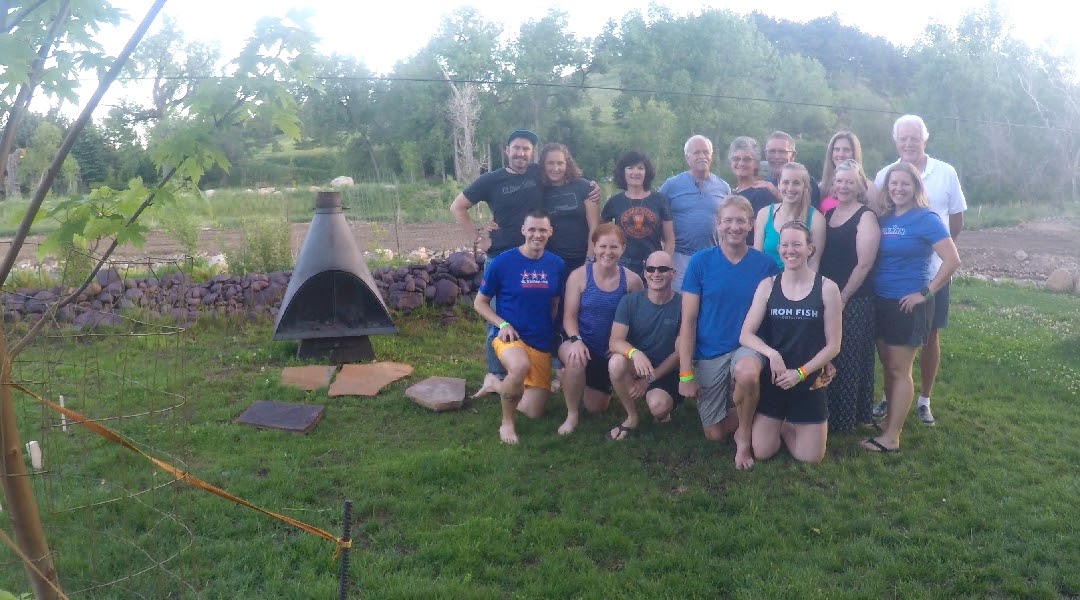
There was only one problem, I had no time. My Navy training schedule was jam packed for 6 months – most of it away from the family. Then I had to move the family to our next duty station and report to my ship by September. Then the detailer sent me an email, saying a two day stop in Jacksonville, FL had been shortened to one day in June. This gave me a free Monday. My first thought was to hang around in San Diego an extra day and just bike. Wait, wasn’t there an Ironman in early June somewhere? Yes-Boulder! So here was my new travel itinerary: Leave DC on 03 Jan and fly to San Diego. Attend a Navy school Monday through Friday. Friday afternoon fly to Denver and somehow get to Boulder. Race Sunday. Monday hobble my way to the airport and down to Jacksonville for a day of meetings on Tuesday. Then finally fly home. Yeah, this was tight, but A – didn’t involve being away from home any longer than I was already planning to be, and B – doable. And Bonus! Davita, a swimming buddy from the old days and her friends were already signed up and they allowed me to latch onto their crew. My father, seemed to have gotten the Sherpa bug from Susan in Wisconsin, and he offered up his services again as well. I was set.
Race Week
I flew to San Diego Saturday to adjust to the time change and get a little riding in. Dan offered to let me suck on his wheel for 50 miles and provided a great tour of the surrounding areas. Only one problem – there was no sun. Dan swears there was an epic view of the valley and ocean from the top of Mt. Solidad. Can you spot it?
Class went uneventfully that week and I enjoyed fish tacos and local brews (carbo loading right?). Wednesday night I went for a last easy spin and ended up with a flat rear tire at the end. No big deal. Easily fixed and boxed up for flying on Friday. After arriving in Denver my father and I headed over to downtown Boulder for dinner. We arrived at the house late and met the Ann Arbor crew and got some rest.
Saturday after breakfast and a healthy dose of black coffee I set out to get my packet and bags.
Let’s do this!
The Man, Dave Scott!
After that, well there’s no sugar coating it. It was rough. Re-assembling my bike I discovered the front tire had a blown sidewall (it had less than 300 miles on it) and the rear wheel axle was smashed in and unridable (presumably from airline handling). While the voices in my head raged I calmly went about solving one problem at a time. Put everything I could together on the bike, sorted out my gear bags, and decided renting wheels was plan B if the axle could not be fixed. After about an hour of deliberation race mechanics were able to solve the rear axle and sold me a new tire. I spent the time relaxing in Normatech boots (man I got to get a pair of these!).
Sherpa’s need fresh legs too!
My father expertly piloted us around town and I got all my bags dropped off on time, without further incident.
T2 behind Boulder High School
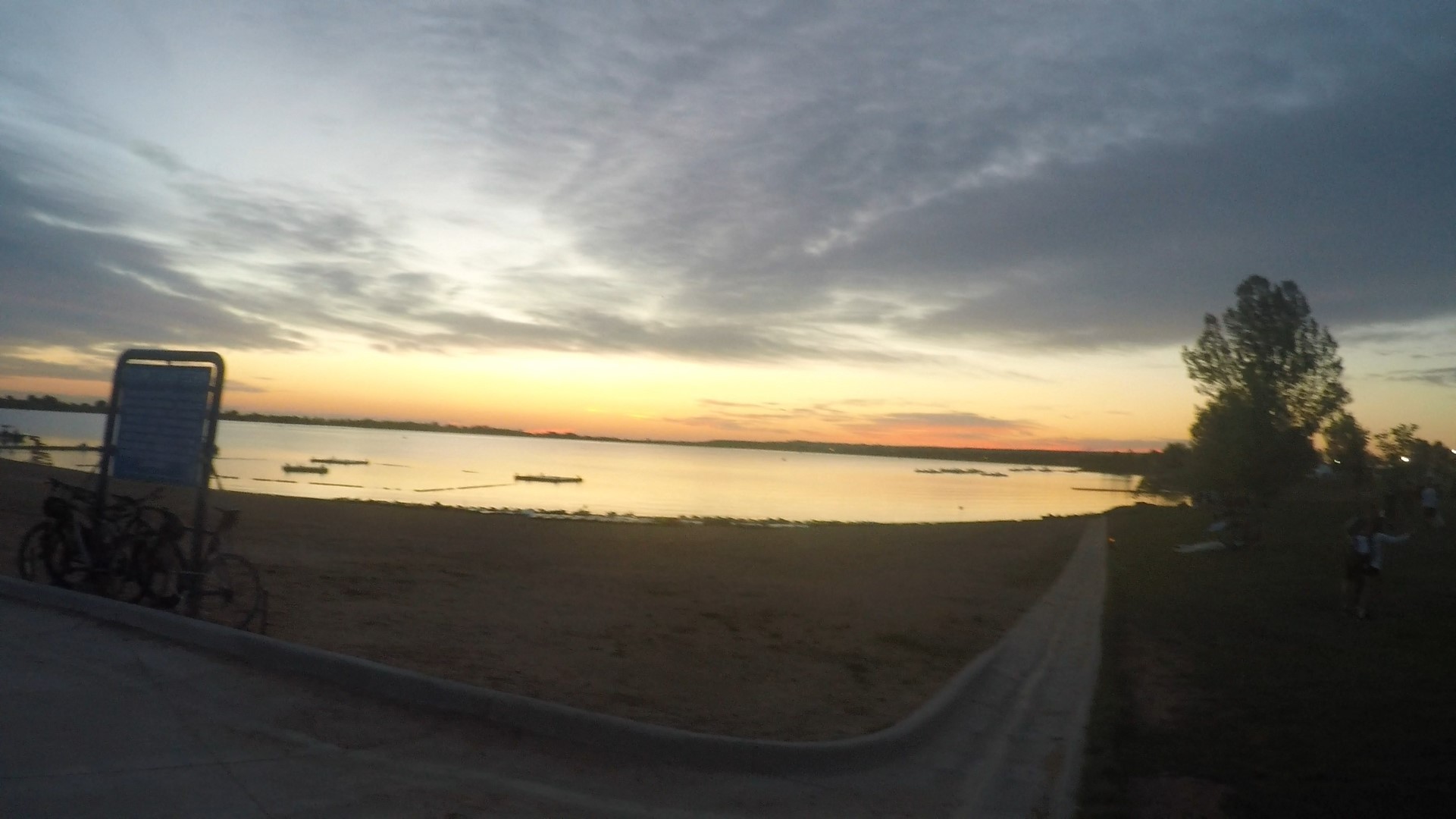
Swim Start at Boulder Resevoir
T1 Bags lined up post swim
My Tririg equipped Felt B2 finally ready for action!
Tomorrow was a new day. The sun will be out; we have mountain views for days; bring on 140.6 miles!
Race Day
Race morning I arrived at the Reservoir ready to race. I knew the altitude would affect me some, and the heat would be intense, despite no humidity. These were conditions I wasn’t able to replicate during training, but pushed the thought out of my head. I generally race the way Pre raced. From the front, as hard as I can for as long as I can. Sometimes it work better than others, but I can’t fathom not leaving everything out on the course. I was feeling good. The legs were feeling froggy.
Swim 2.4 miles
In a new twist, the swim was going to be self seeded instead of a mass start. Being a stronger swimmer, I’m all for this. There’s nothing more annoying than those swimmers who sprint the first 200 meters fighting and kicking all the way. They think they can stay up front and then fail miserably creating obstacles I then have to swim around. We all know you’re not going to be around five minutes later so why are you fighting me for the same waterspace now? Anyway, I opted for the 1 hour group. No sense in trying to kill myself to stay with the sub-hour group. After the pros went off, we unceremoniously walked down the ramp into the water to start our swim. I hit the water and took several long strokes toward the first buoy. Easing into it, I gradually started to pick up the tempo half way down the first stretch. And I started passing a lot of folks. Come on now, didn’t we all just self seed? Why are you up here if you can’t keep up? Self seeding only works if everyone is honest about their swim abilities. I kept up my tempo through the first half, checked my watch and took in the mountain views in the background. I could get used to this. I labored a little more on the second half, trying unsuccessfully to find feet to follow. Coming out of the water my watch read 1:02. Right about where I wanted to be.
Bike 112…er 114 miles
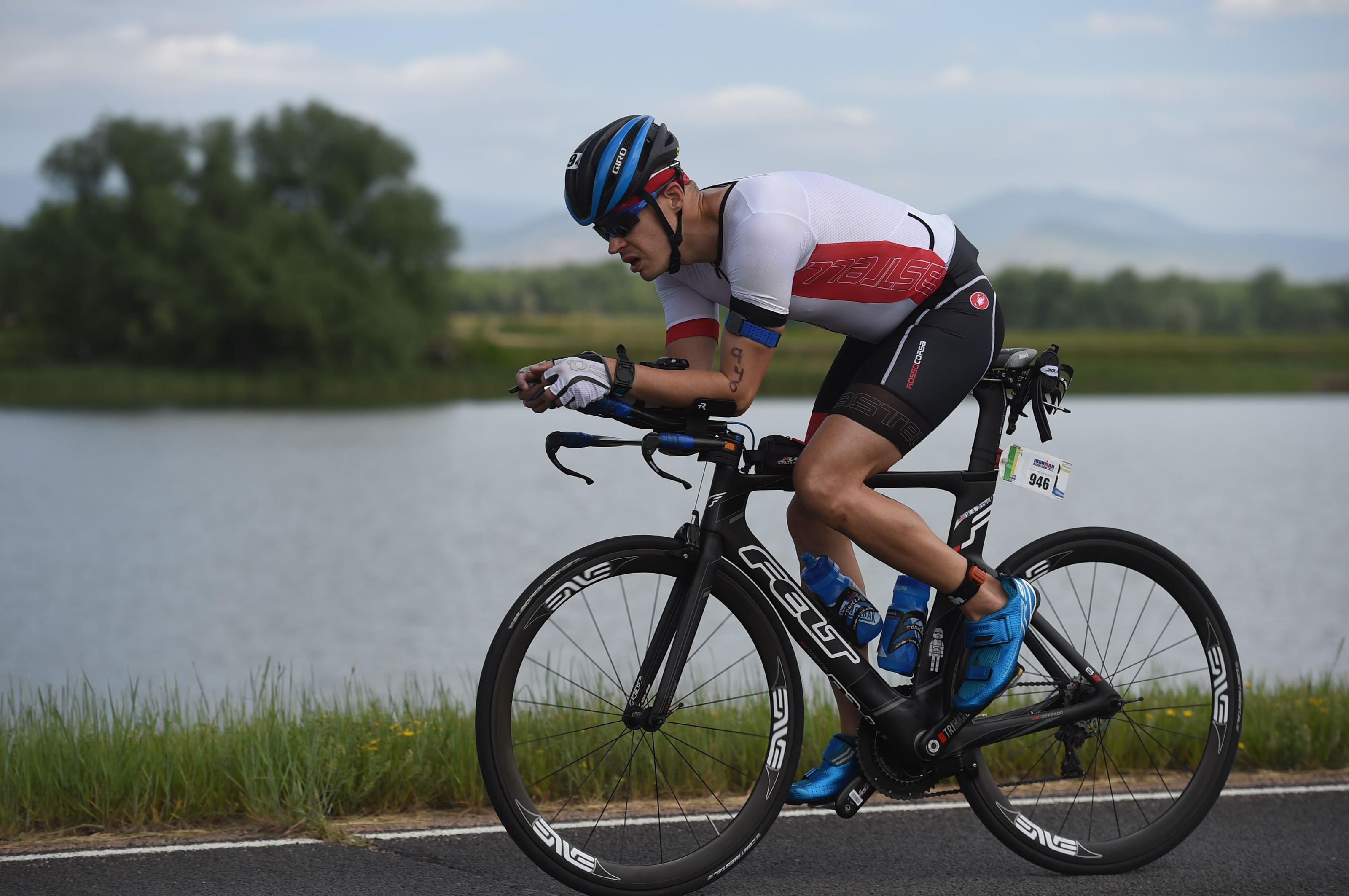
I dawdled a little too long in T1 but came out right behind Davita! She had a great swim and was off to a solid start to her first Ironman. Sadly she left her tow cable at home and wasn’t up for pulling me for 112 miles so off I went. The course is 3 loops through Boulder county with majestic mountain views all around. With the shenanigans on Saturday I hadn’t gotten a chance to preview the bike course. So lap one was my recon. The legs felt good. I started into my routine of eating and drinking every 15 minutes taking mental notes and settling in for the long ride ahead. On paper the Boulder course seemed easier than Wisconsin. Elevation wise anyway. There would be no trips up Barlow or three sisters to tackle. But the course still offered it’s own challenges. The long slog and false flat up Nelson Rd quietly sapped my legs. Then I discovered the glorious downhill sections on St Vrain Rd and the fast flats on 75th and 73rd St. Big ring here I come! I took a water at ever aid station and poured it over me to keep the heat at bay. Lap one came to an end and I flew through the Reservoir transition area headed for lap 2. Turning back onto Jay Rd I passed a rider giving his bike a shower. Now I know people do this, but really folks why? None of us are getting paid, and are you really that fast that 90 seconds in the head is going to kill your race? Anyway, I started to pick up the pace steadily building into lap 2. I was crushing my own mental time stamps and my power and heart rate weren’t exploding. The legs continued to feel good. Finishing lap 2 cruising through the Reservoir I saw my father. Sitting up I gave him a big grin and shrugged my shoulders. Ain’t so bad! I continued to crush my early time estimates, keeping my pace up over 22 mph. I stayed areo for long glorious stretches taking in the mountain views and still the legs felt good, the effort under control. What altitude?
Get aero!
After 5 hours I was still trucking along feeling good at the end of lap 3. I rounded toward the Reservoir and took the turn back toward downtown Boulder and the high school. My legs were still feeling good feeling a bit worn after the long effort but I shifted my focus to getting ready to run. 112 miles came and went. Where’s the high school? Side street after side street and short stretches on a bike path…no high school in site. Somehow I missed the note that this course was 2 miles longer than normal. After 5 1/2 hours in the saddle and not expecting those last two miles was a small mental blow. Overall I came into T2 feeling fresher than I did at Wisconsin. It was the best 5plus hours I’ve ever spent on a bike.
The Run 26.2 Miles
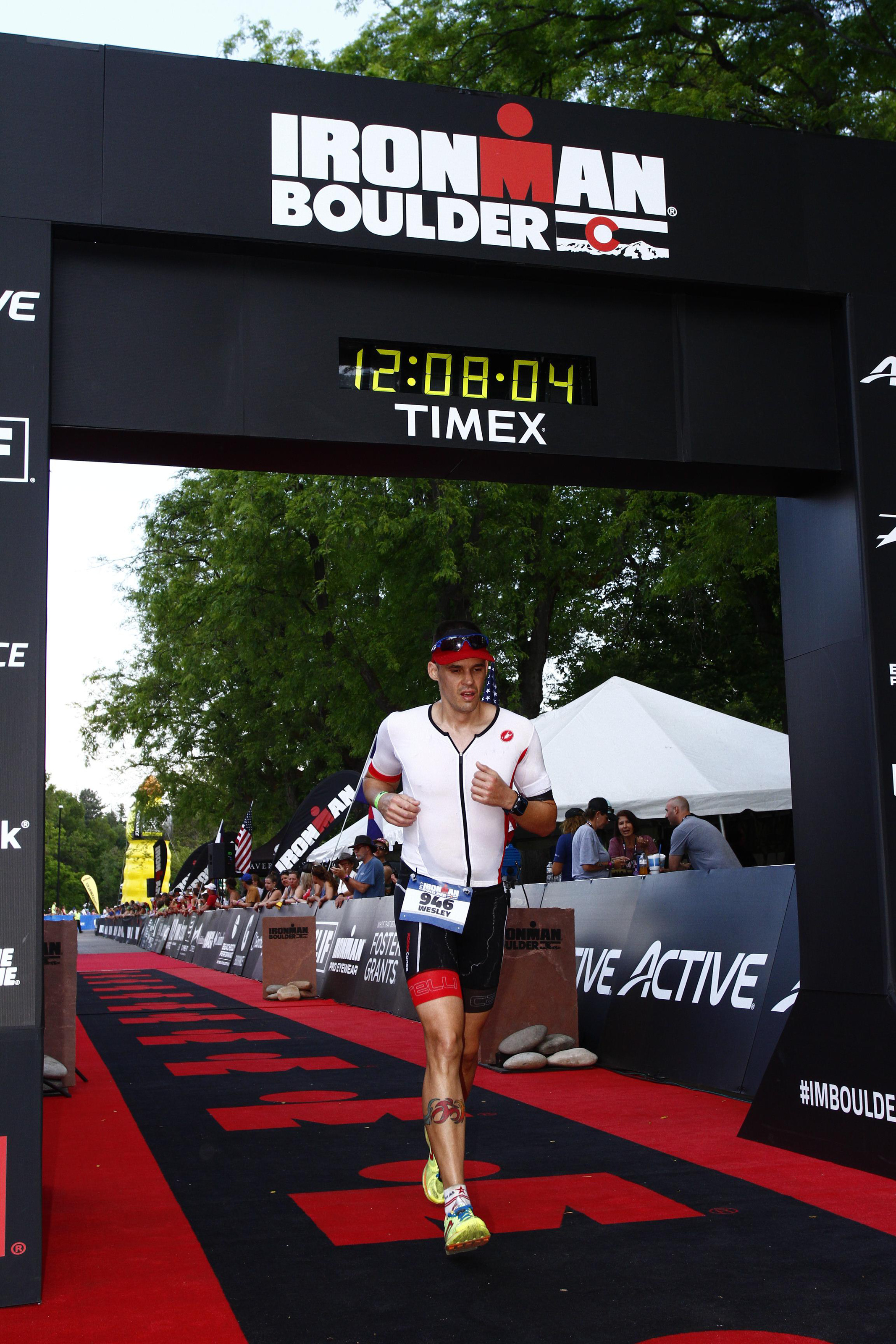
I took my time walking through T2 to stretch the legs out and my lower back. Grabbed my bag and nutrition supplies and shuffled out onto the run course. For the first couple of miles everything felt just like my long training runs. My mantra was short quick strides. “Quick, quick, quick,” I repeated over and over again. I got this. 9 minute miles gets me well under a sub 11 hour finish. I was executing beautifully. Visions of 10:45 danced in my head. I smiled. I can do this. At around the 10 mile mark I noticed my stomach starting to churn. A short time later, it was rocking the Floyd Mayweather combos on me from the inside. Nausea overtook me. I dropped from running to run/walking a 3min/2min ratio to maintain forward progress, hoping to get things under control. Then I just staggered. I could not stand the sight of solid food at the aid stations. I knew I needed it, but just looking at it made my stomach churn. Run/walking got me through 4 more miles before I spent some quality time in a port-a-jon. Twice. On that second lap I went into a real dark place for a couple of miles shuffling from aid station to aid station trying to find the right combination of food and drink to get moving again. Nothing was appealing. I saw Davita a couple of times on the run. She said later I looked like I was in rough shape. Around mile 20 I mentally came back into focus but my body was thrashed. At mile 21 Dave from Chicago came up alongside and said “come on, shuffle with me to the finish.” So we shuffled to the end together. I love this unspoken camaraderie that can be found at any Ironman race. Thanks Dave, I needed that!
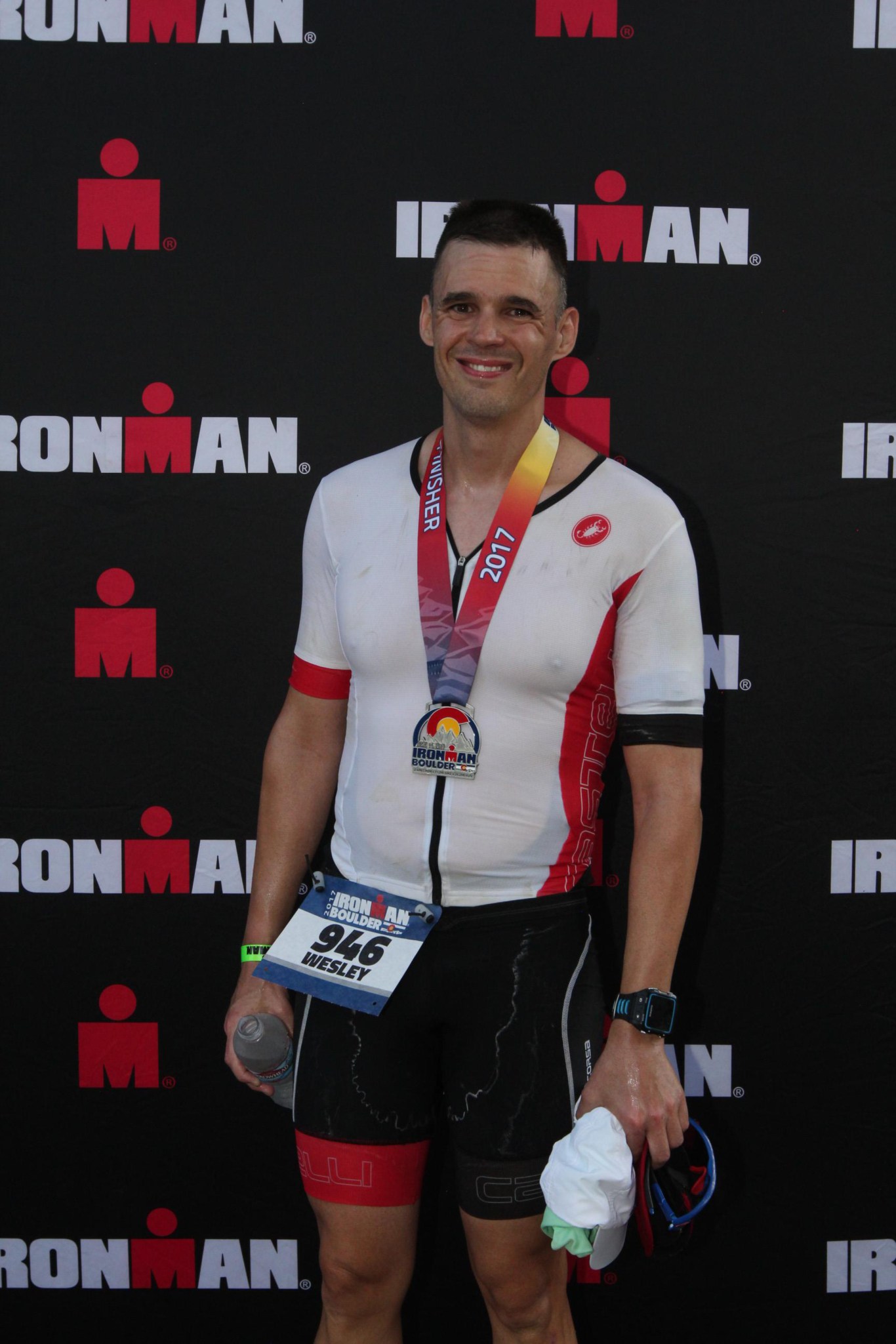
Crossing the finish line I actually heard Mike Reily’s proclamation, “You are an Ironman!”
Afterwards, I spent some time in the medical tent coming back to life. Although I didn’t feel great, I wasn’t as bad off as I thought. “Flat lander,” the EMT said shaking his head as he took my vitals. Chick broth is a miracle drug; I downed three cups of it. I now understand why triathletes flock to Boulder. It was an awesome race venue. I’m glad I took advantage of the limited time window I had to compete. Next time travel allows for more time to acclimate I’m going back 8-10 days prior to race day or air lifting in 20 minutes before the start. The back half of the marathon is definitely where the rubber meets the road. That’s where the tough dig in. My overall bike nutrition plan may not be as dialed in as I’d like to think. After this sea tour me and Ironman are going to round and round again. I’ll crack this nut.
“Wo! I feel good, I knew that I would now
I feel good, I knew that I would now
So good, so good…”
Nine hours after I started this race – my first attempt at an Ironman – James Brown’s immortal lyrics ran through my head. I did feel good. Really, good in fact. Who’s legs are these? I can’t ever remember finishing a bike leg and having my legs feel this good. No cramping. No muscle spasms. No hint that I’d been on the go since 0700 and it was sometime after 1600. How long can I keep this up? I wasn’t sure but I was going to find out. Before we do though, I must explain how I got here…
Traveling to Madison
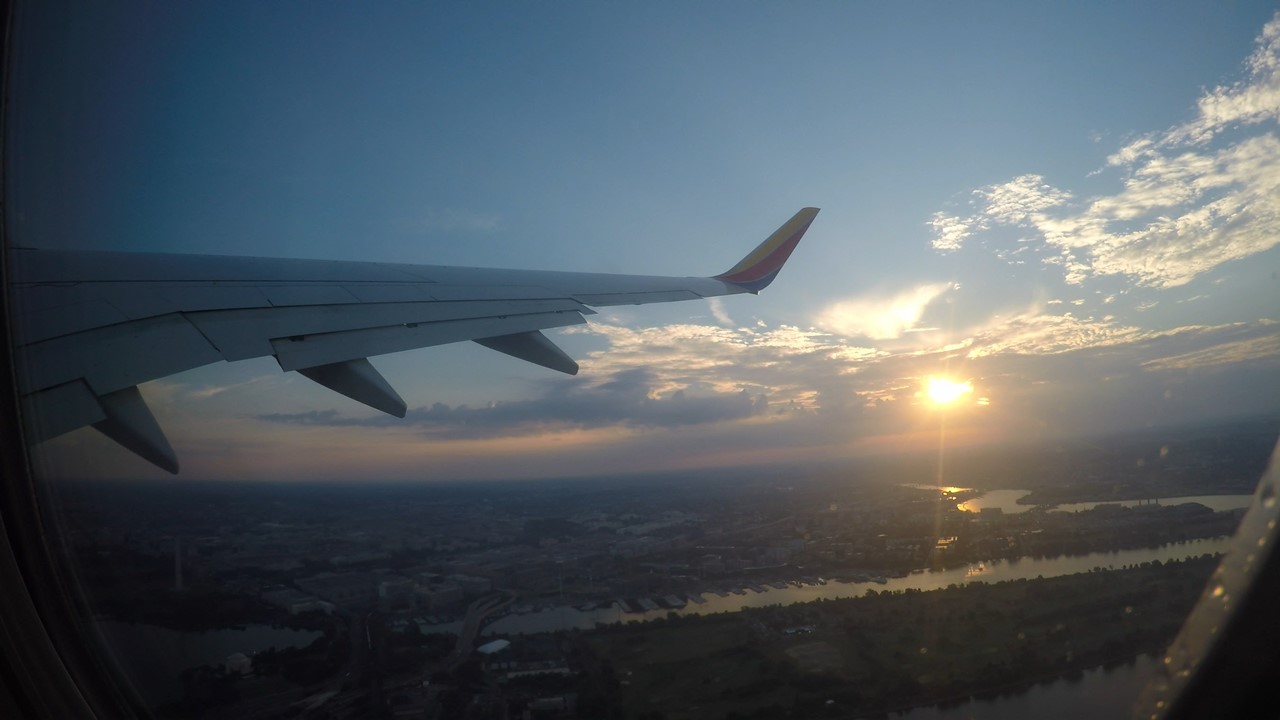
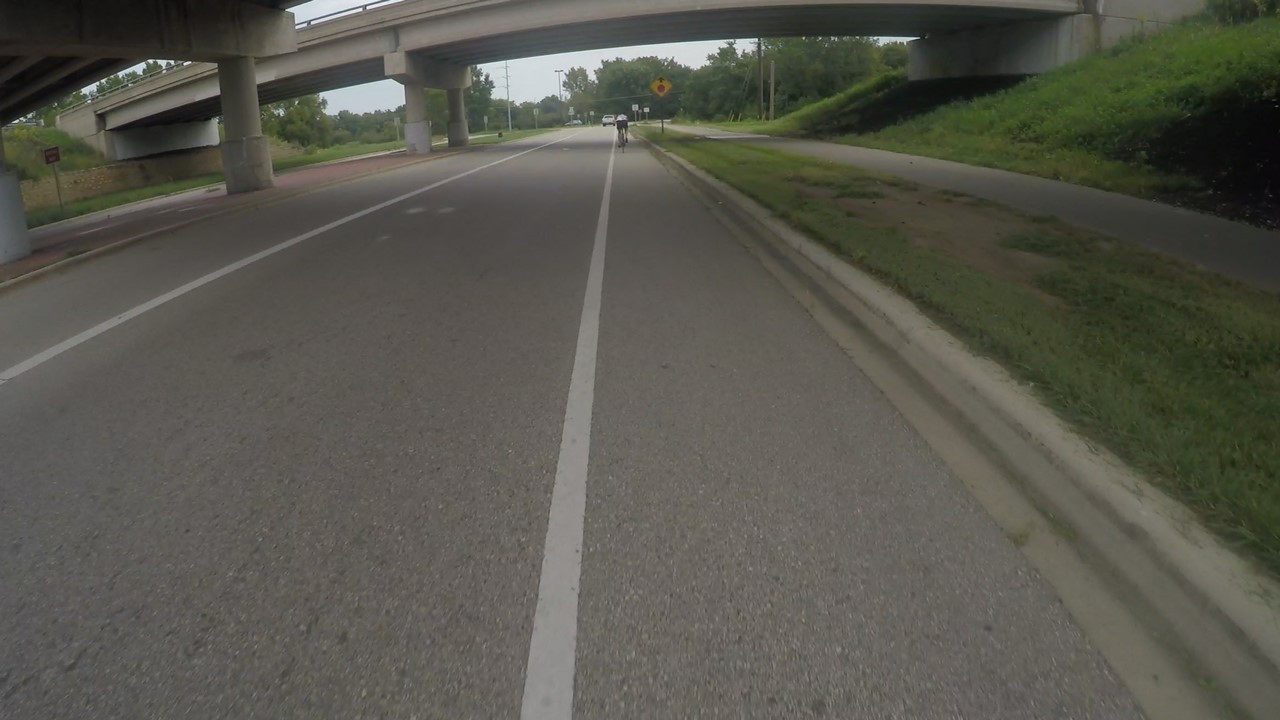
I left for Wisconsin on Thursday morning. Well, really early Thursday morning. Here’s the sun coming up just after 0600 over one of my frequent training grounds, Haines Point, East Potomic Park as the plane takes off from Reagan National Airport. I’ve spent many hours circling that small island on my bike and on foot getting ready for my first Ironman.
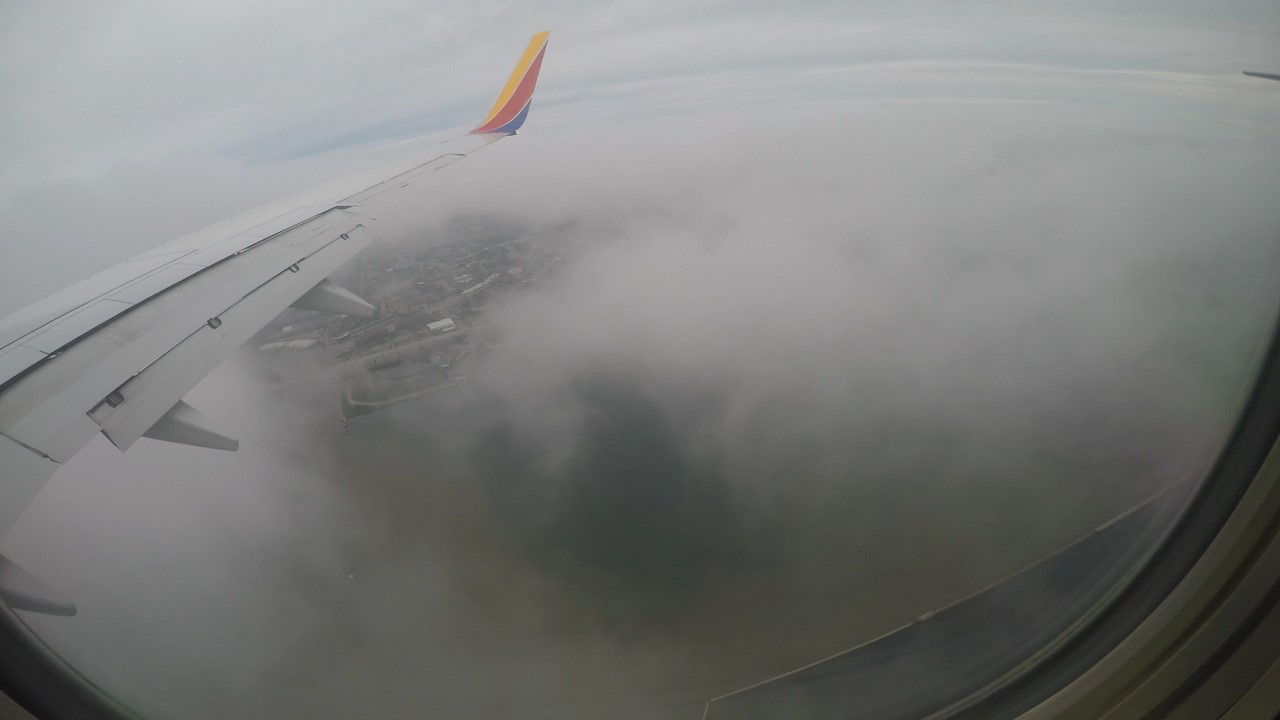
Swooping in from the clouds a couple hours later I took in the swim course from last year’s USAT National Championships. Susan would pick me up a little while later, and off to Madison we rolled. Susan took care of all the logistics. She booked the hotel and knew exactly how to get around Madison and the surrounding areas. It required zero effort on my part. She had this race wired so I blindly went where and when she told me. After a quick hotel check in we rolled to the Athlete Village and breezed through the registration.
We took an opportunity to refresh our legs with a stop at the Normatec Booth. Oh, man do I really want a set of these. Afterwards, we drove the course through cheese land. Friday we took an opportunity to ride the “stick” from the hotel out towards the 40 mile loop start.
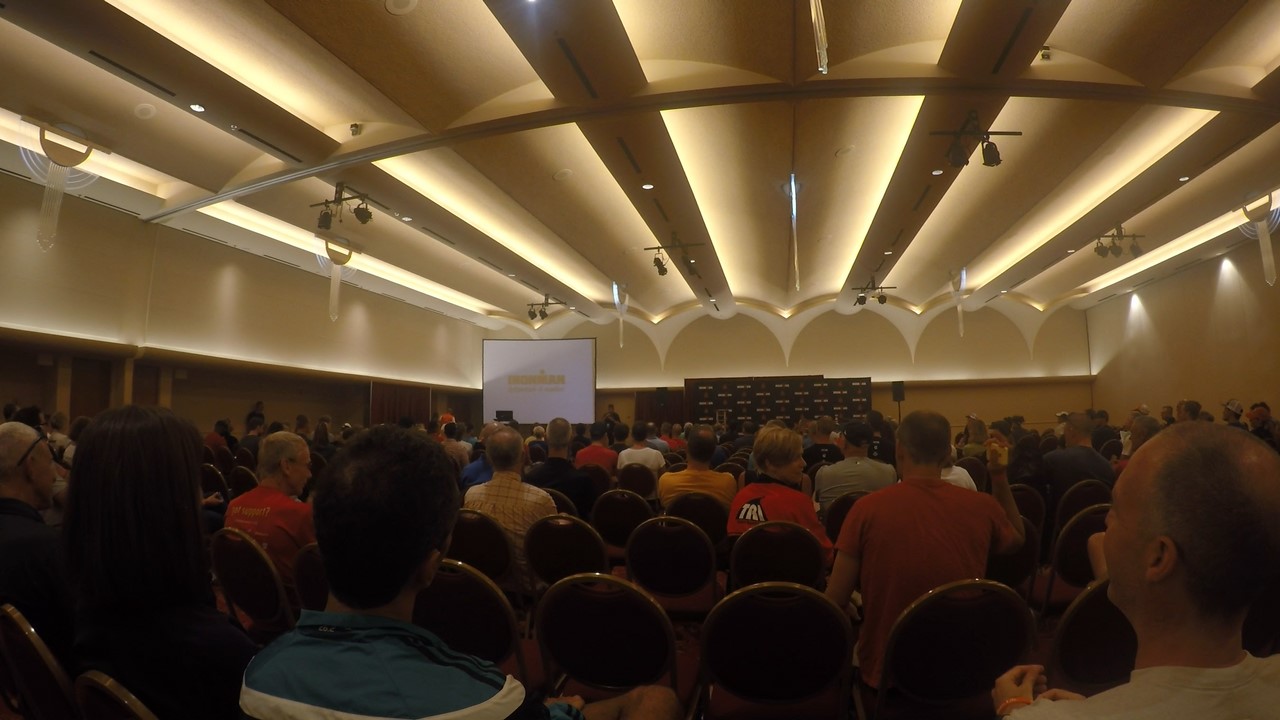
Again, I blindly followed. Susan led the way on her new Boardman Tri bike. Hey, she had intervals to do, and I was just spinning my legs, keeping them loose. Afterwards I went back to check out an afternoon session of the athlete briefing.
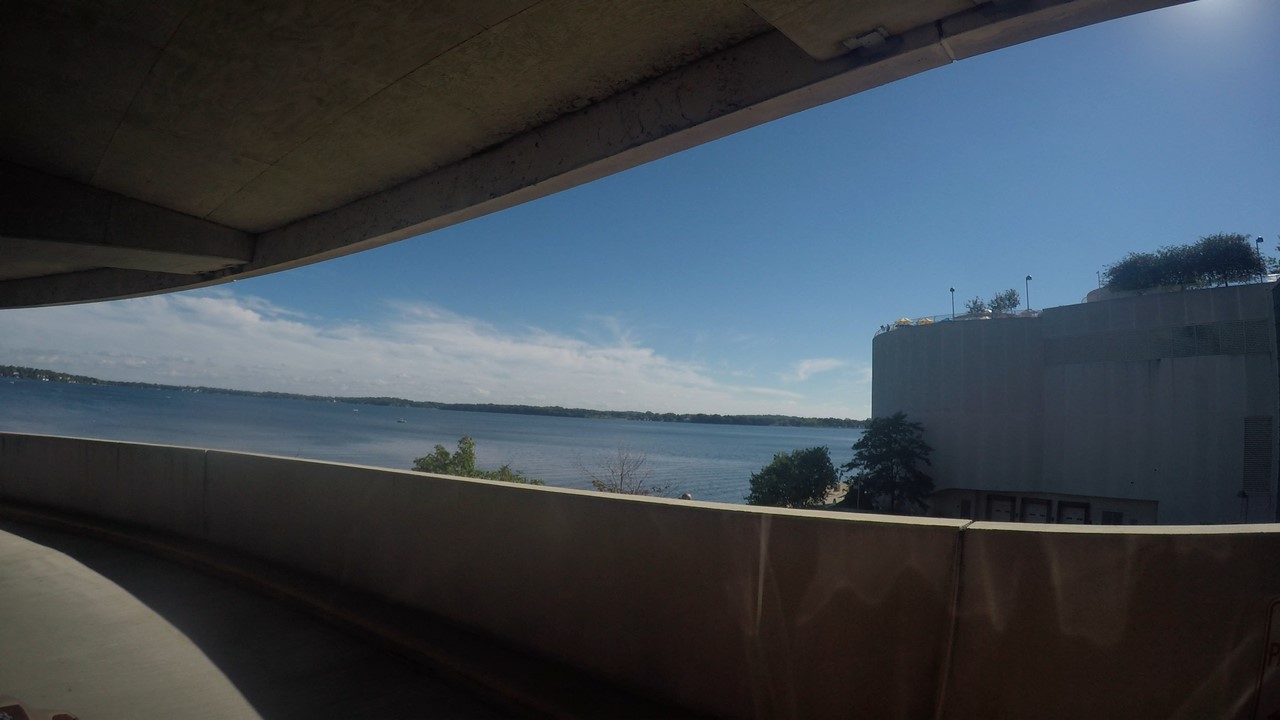
Views abound from the convention center. The weatherman called for blue skies all weekend.
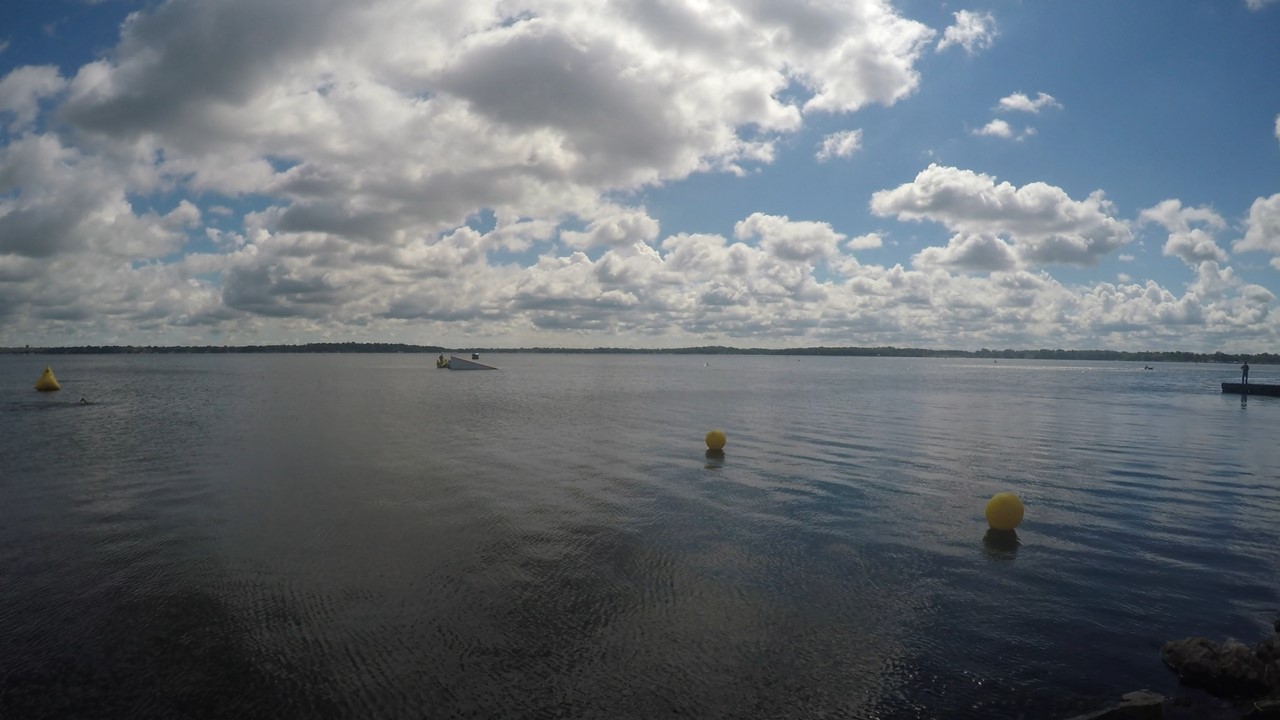
Not a white cap in sight on the lake. And it would stay that way the entire weekend.
Saturday gathered my bike and run gear together in the respective gear bags and dropped my bike off at transition.
Bikes, bikes and more bikes
My Tririg equiped Felt B2 ready to fly!
Race Day
Sunday, my alarm went off at 0400, but I was awake an hour earlier. sleep only came from 2300-0300. I choked down oatmeal, a banana, and coffee. It wasn’t much but I needed something in my stomach. I grabbed my special needs bag, bike water bottles, wetsuit, goggles and cap and we headed for the transition area and swim start by the convention center. Once there I loaded my water bottles up and filled my top tube bag with dark chocolate and fig bars and scratch labs drops. Then I found body marking, because apparently our entry fee didn’t include tritats. That completed, Susan and I found a spot to chill by the swim start and settled in; it was 0600 and the race start was slated for 0700.
Swim – 2.4miles
A little after 0630 I entered the start coral and wandered with the herd into the water to await the cannon. The water was 72 degrees and my sleeveless wetsuit kept me afloat with minimal effort as I worked my way to the far side close the Roka course buoys. At 0645 The pro women’s field started. I watched them go with anticipation. I am most at home in the water during a triathlon but I have never started a race with 2500 of my closest friends floating around me. I had about 1-2 rows of swimmers in front of me, countless rows behind me, and as soon as the cannon fired, signaling the start, their collective momentum carried me onward. I did not take a hard stroke for the first 150-200 meters. The draft and churn seemed to just carry me along. I eased into my stroke and started to work my way around swimmers always looking for the next set of feet to draft off. After the first two turns space opened up a little and I settled into a rhythm for the long stretch back. Soon the buoys changed from yellow to orange signaling the half way point. I felt strong and relaxed. I completed two more left turns before heading back to shore and the swim exit. I could tell that space had really opened up around me and wherever I was, we had opened up a gap on the rest of the field. Finally, the exit was in sight and I jumped out with one woman on my right.
Easy swim day
Wahoo!
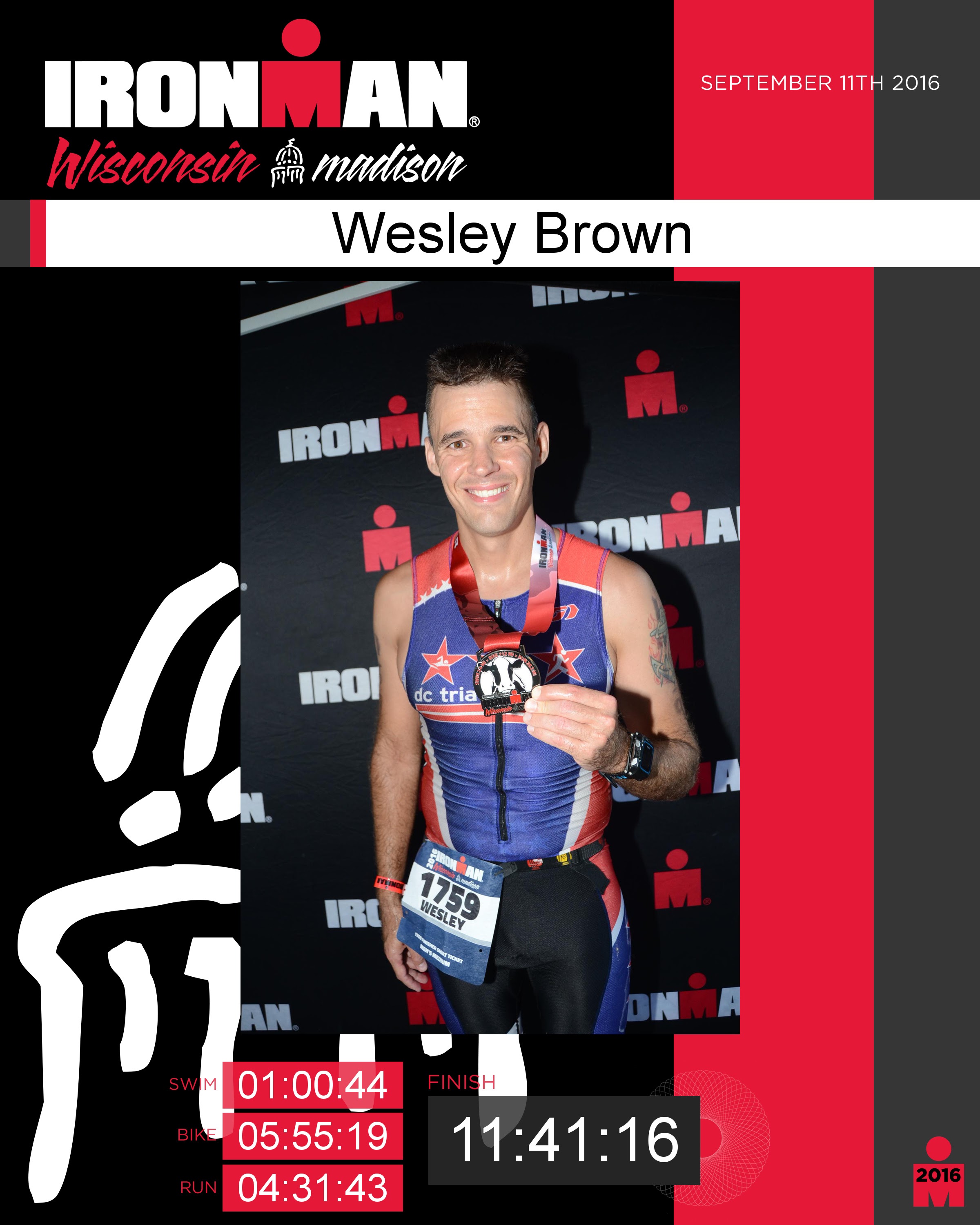
Hitting the lap button on my Garmin I saw I was right on time completing the swim in just about one hour (1:00:44). I didn’t feel like the swim had taken any longer than a 70.3 but time doesn’t lie. One down; two to go.
T1
Jogging up the path two volunteers shoved me to the ground and ripped my wetsuit off before I could blink. Then I ran up the three story spiral through a screaming throng of crazy triathlon fans and into T1. It is hard to stay within yourself when all these excited fans are willing you forward. I ran straight to my bag and into the changing room. Donning my bike jersey, gloves, and helmet another volunteer shoved my wetsuit and goggles into the bag and pushed me out the door toward my waiting bike. I clopped all the way through transition wearing my bike shoes. Next time I think I’d rather carry them to my bike and put them on there.
Bike-112 Miles
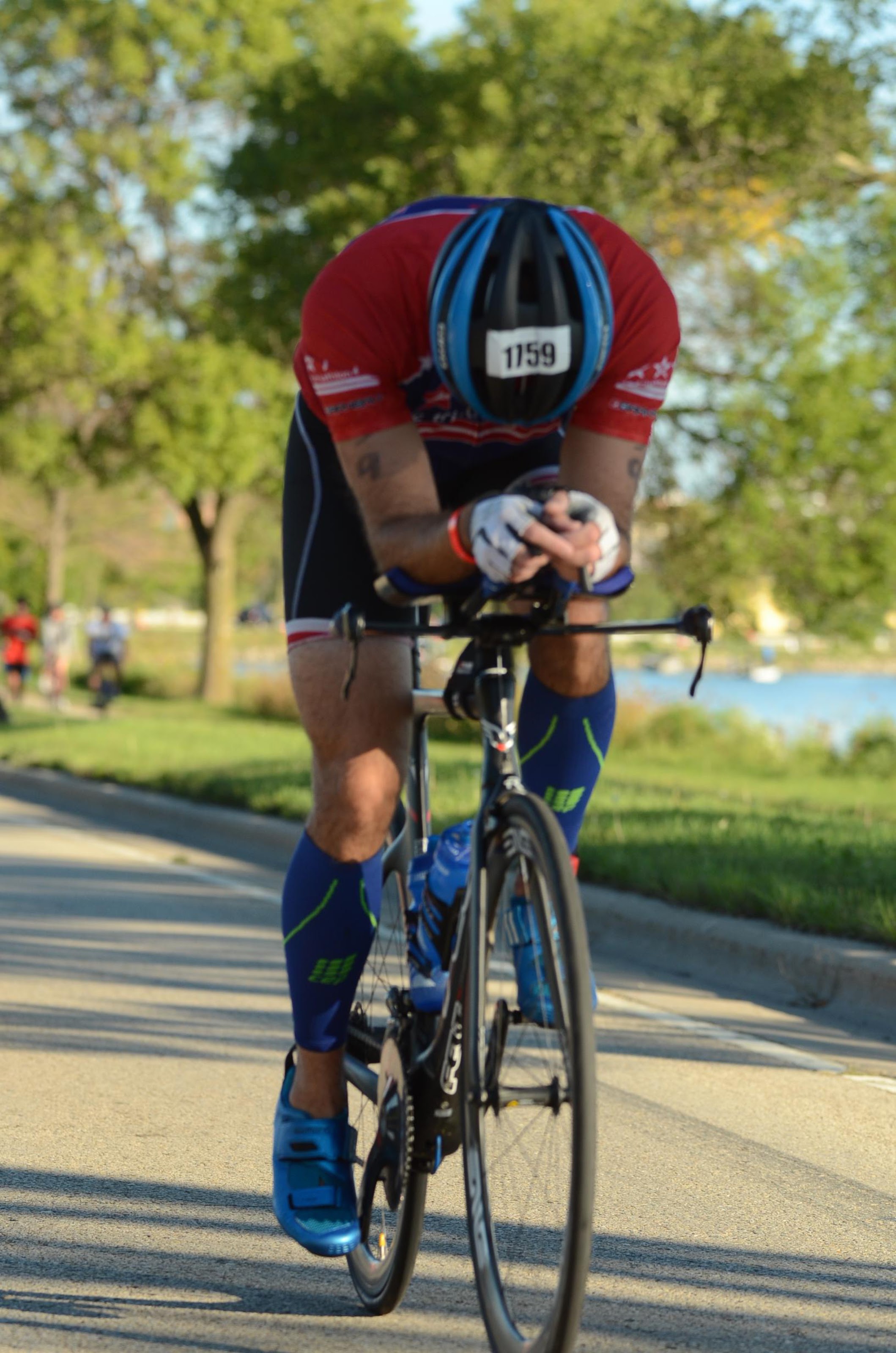
Once on the bike I spun down the opposite spiral and out onto the stick headed toward the city of Verona and two forty mile loops. Shortly into the bike I hit a sharp bump in the road which threw my areobars out of alignment – i was almost staring at the ground. I wrestled them back up, although now I felt like a praying mantis. Several miles later after more jarring road vibrations it ended up back at normal. As I worked my way through the early miles I had to remind myself this was going to be a long day. I was just over ninety minutes in and burning matches now would cost me later on the run. “Calm down” was my mantra.
My game plan had been to hold the low end of my tempo power, keep the heart rate below 148 and spin up the hills. All while taking in about 280 calories an hour, alternating drinking and eating every ten minutes. It’s a lot to think about while trying to keep the rubber side down. The course took us through rolling farmland while visons of cheese curds, brats, and beer danced in my head. My back and neck also ached and I hadn’t even reached 30 miles yet. The queen climb of the day was a short but steep pitch up Barlow Road at about mile 38 which we would only see on our first lap. I resisted the urge to attack it and spun up without incident enjoying the screaming fans lining both sides the road. Pretty much the closest I’ll ever get to a Tour de France experience. Earlier in the week my coach had said, “you’ll reach a dark place about 70-80 miles in. Push through it and get ready to run.” Fooled you.
The darkness took hold between 30-45 miles. My neck hurt. My back ached. No idea why. I’ve spent plenty of time on this bike in this aero position with no issues. After, finishing the first loop things started looking up. Miles just ticked by in packages of ten. Sixty. Seventy. Eat. Drink. Eighty. Susan and my father had been volunteering at the aid station around mile 80 and I stopped to refill a bottle for the final push back to Madison. All I saw were dudes in yellow shirts and a minion. Ninety miles down and I could see the light at the end of the tunnel. Well, the bike tunnel anyway. I could not stay comfortable in any position anymore. But seeing Lake Minona gave me something else to occupy my mind: I was close to running my first marathon. What, you ask? Didn’t I run a pre season marathon to get one in my legs? Come on now, what fun would that be? Marathons should only be run after swimming 2.4 miles and biking 112. When I finally reached the convention center I spun back up the three story spiral (there should be an elevator option for 05 and above; just saying) and chucked my bike a the first volunteer I saw. Hey, the guy giving the race briefing was right, I didn’t care about my beloved carbon beauty at all anymore. Bike split: 5:55:19.
T2
Stumbling into transition my run bag was right where I left it yesterday sandwiched neatly between 1758 and 1760. I followed a couple guys into the changing tent where a volunteer dumped the contents of my bag on the floor. I stared blankly at the mess at my feet, knowing what I needed to do and in what order but not moving. Thankfully, the volunteer had seen this blank look before and started prodding me. I snapped out of it and stripped of my bike jersey in favor of my tri top. socks. Running shoes. Gu in pockets. Glasses. Visor. Race number. Quick hit of Hot Shot and water and I was out the door. I was met with more enthusiastic fans and sun beating down on me.
Run-26.2 Miles
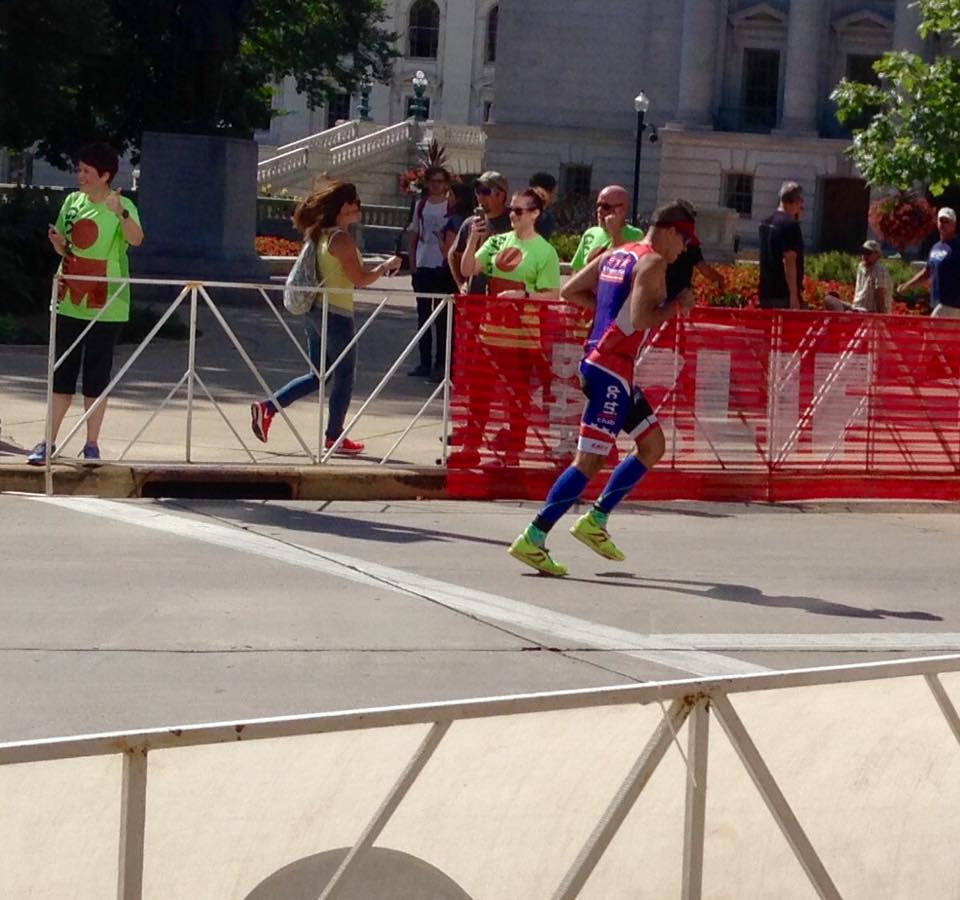
Susan met me running along the block next to the capital and kept pace for a block shouting encouragement. That’s her above in the yellow shirt and bag, running with my GoPro. Okay legs, ease into this. I had 5km to find my running legs. Gatorade, water, and ice at the aid stations. “Hey, you lost your bib number,” someone shouted. Sure enough mine had fallen off my race belt and was blowing in the wind behind me. Curses. Of the several race belts in my drawer I grabbed the worst one for this trip. I shoved it in my pocket figuring I’d fix while walking through an aid station. I motored on ticking off miles through the streets of downtown Madison.
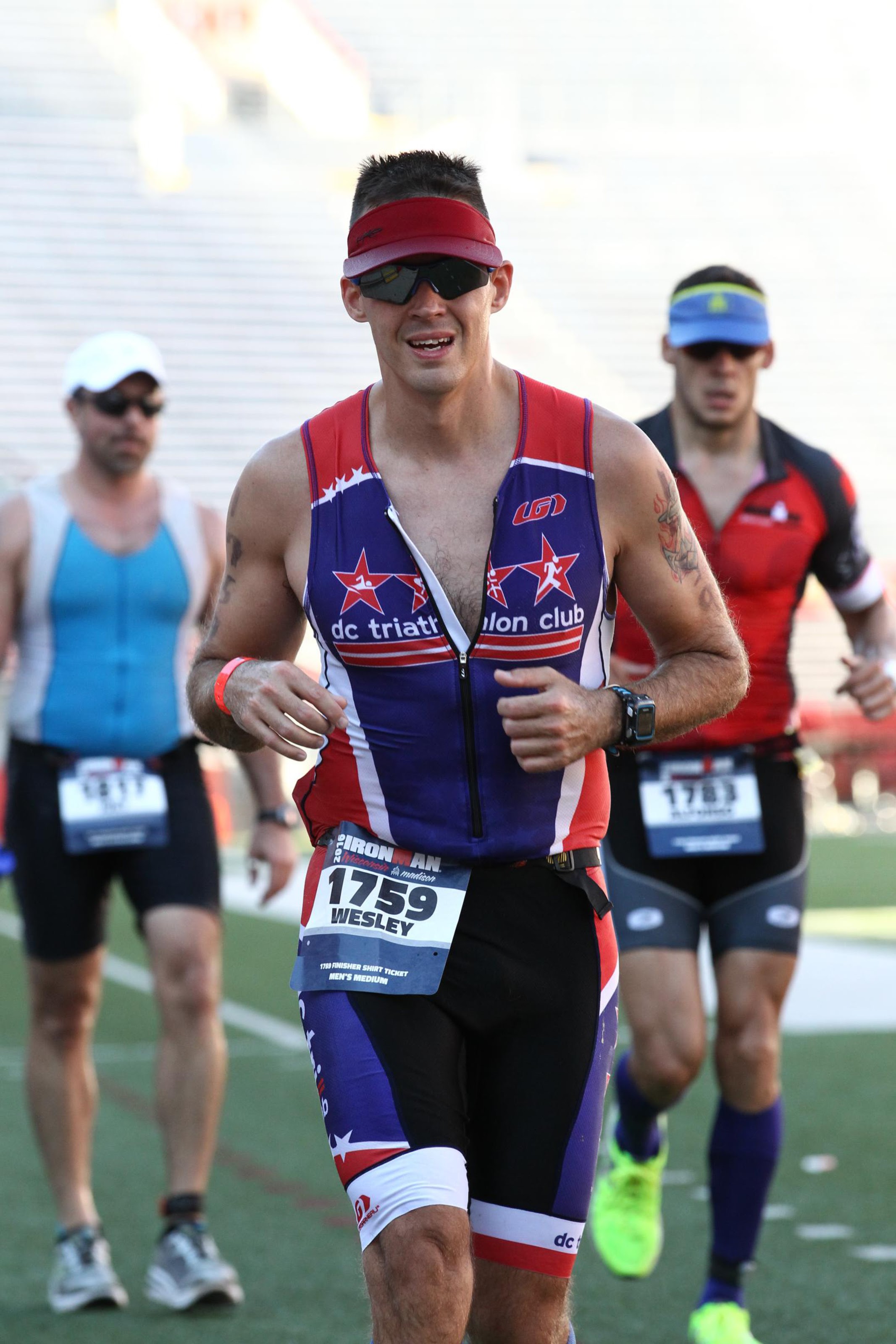
Hey, look a stadium. It was neat running a lap around the football field that had just yesterday entertained several thousand screaming fans. Now wouldn’t that be cool, fill the stadium with spectators for Ironman? 10km down and I still felt relatively good. I can keep this up. Thundering down State St I drew on the energy of the crowd and saw Susan and my father twice on the out and back. I watched the miles tick by on my watch. I was aware of the time and distance that had passed over the course of the day but it stilled seemed surreal. As I approached the half way point I pondered whether or not to get my special needs bag. All the advice I received pre-race can be summed up in two words: Seven-Eleven. Put $10 worth of stuff that I’d grab at a gas station mid long ride to keep me going. The problem was pre-race nothing sounded appealing. I opted against using one one the bike. For the run my bag had one single item in it: a can of Red Bull. Now, I don’t normally drink energy drinks. I’m more of a coffee connoisseur. But for some reason as a volunteer held the can out for me, I shrugged and nodded. She popped the top and I grabbed it gulping it down. Eh. It really didn’t have much effect on me, but it was something different.
I tossed the empty can at the first opportunity and turned my focus to hunting. It was time to start increasing the effort and hunting down anyone in front of me. I had this crazy idea in my head I could negative split the marathon. Mile 14 came and went. Mile 15 disappeared somewhere behind me. I got a huge shout out from DC Tri clubber, Stef, as she closed out her first lap. By mile 16 I realized the pace was not matching the effort. And damn my feet and heels hurt now. Crap what’s that pain in my quads? Every step after mile 16 was my longest run ever. And every step hurt. My body was starting to rebel against my effort on the day. By 17 the Ironman-shuffle had taken hold and wouldn’t let go. By mile 21 another fellow DC Tri clubber, Chris, caught up to me and introduced himself. That’s one of the things I love about our club. I meet new people at every race and always enjoy hearing, “Go DC Tri!” out on the course. We chatted for a 30 seconds and then Chris pulled away. I made a half hearted effort at matching his pace, but my legs were toast. Finishing was not in question, but that finish line wouldn’t come soon enough. As I shuffled through one of the last aid stations someone shoved a warm cup of chicken broth in my hand. Why not? I gulped it down. Damn, that was good! Now I know what to put in my special needs bag! The final miles are a blur of shuffling and dragging myself toward the red and black Ironman finish tunnel. Reaching the capitol square and the last two blocks my legs found renewed form and I felt more like a runner, upright and strong. I veered right at the split and the finishing line stretched out in front of me.
I listened hard, but couldn’t make out Mike Reilly’s voice or hear much of anything other than screaming fans. I crossed the finish line hardly able to comprehend what I had just accomplished.
Immediately two volunteers grabbed me and forced me off to the side. Do I look like I’m in that bad of shape? I didn’t fall I swear. “Are you ok? Do you need anything?” How bout that free beer someone’s sign promised me 10 miles ago I thought. They kept asking me questions and honestly I didn’t feel like talking to anyone, but I understood and was grateful for their purpose. I got my obligatory finishers picture taken, assured my two new friends I was fine and went over to where Susan and my father were waiting.
I laid on the ground for a while. Susan and a friend wandered off to get my bike. I’d probably would left it there, if she couldn’t have gotten it. Eventually, I stiff-legged it over to the athlete food tent and sat down to choke down some pizza. Susan returned with my bike and bags and we headed back to the hotel. I intended to clean up and return for the 2200-mid-night finish line party, but once I laid down I was gone. Susan went back and cheered on a few of her friends finishing up; i was out cold.Monday, morning Susan and I got up early and headed over to the athlete breakfast and finish line store. After all, I had to take home something to memorialize the event!
Post Race Thoughts
I can’t thank my sister Susan and Father for coming to sherpa and cheer me on. Susan made sure I didn’t have to think about anything but racing. And even brought my bike back! I highly recommend Ironman Wisconsin to anyone looking for quality run event with Mid-Western charm.
After crossing the finish line my thoughts were so scattered and incoherent. Exhaustion. Joy. Relief. Elation. Watching the miles tick by on my watch I never fully grasped how far I traveled. Or how far I had to go for that matter! It is hard to get into triathlon and not entertain thoughts of doing a full iron distance event. After all, the first triathlon was 140.6 miles long. I’ve long known I would eventually complete one, but I wanted to do it on my terms and compete from start to finish. From my first triathlon in 2005, it’s taken me a while to put together the consistent training to feel confident in putting together a 140.6 mile day. The last four years have afforded me that opportunity and I had to take advantage of it. I executed my race plan for about nine hours. They say the wheels fall off everyone at some point in an Ironman, it’s just a matter of when. I held on to mine for nine hours. I can’t complain. That last 13.1 miles was rough, but it could have been worse, especially given this was my first marathon. Looking back, I think I could have attacked the bike a little more. I was scared to death of blowing up. My normal race plan is go as hard as I can until I can’t go anymore. I knew that wouldn’t work here, but I’ve got more to give on the bike. It may not seem like with a 4:30 marathon, but my run legs have come a long way since hobbling through the Nationals last year. For now, I need some rest and recovery. This will not be my last Ironman, but I’m not sure one is in the cards with my Navy training schedule next year. And then it’s back to sea duty. So If I get to race, it will definitely be a shorter endeavor, but Ironman will stay in the back of my mind.
What is swimrun? A couple of years ago I came across a bizarre race while surfing the interwebs. It was created by a few crazy Swedes and involved running in your wetsuit and swimming in your shoes traversing from island to island in beautiful local. … Continue reading Swimrun comes to America: Casco Bay Swimrun
It has been a long season of training and a couple of races since the VA Du, and I’ve not really written them up. I followed up the VA Du with the Kinetic Half in May. It’s still a great race, I love the course and hanging out at Lake Anna, but this year’s race wasn’t anything special. I swam decent, rode average and ran. The race really felt more like a long training afternoon. I had a blast camping with the family all weekend and finishing it off with a visit to the local Renaissance Festival, but the race was really just a stepping stone along the Ironman training plan.
Over the 4th of July week we took a trip down to Ashville, NC which allowed me to get out on the trails and roads along the Blue Ridge Parkway. Climbing, climbing and more climbing on the bike as the Tour de France was in full swing. Ah, the mountains are a fun place to play!
Then at the end of July I went for the century-Olympic double at Culpeper. Saturday I drove down for my first century ride in almost 8 years at the Culpeper Gran Fondo. I arrived about 30 minutes prior to the official start and grabbed my packet, which consisted of a bib number, t-shirt and socks.
The day started off overcast, and I didn’t expect rain; then it started to rain. I took my time getting my bike ready and nutrition together hoping for it to pass. Despite a fully stocked course I intended to ride with my Ironman race nutrition as much as possible. I took so much time I missed the official “start.” Oh well, I hopped on my bike and pedaled off in the rain in search of a group to ride with. I passed a few fellow DC Tri Clubbers, but they weren’t doing the full 100 miler. On I road passing, well, pretty much everyone. I really wasn’t pushing the pace yet, but I couldn’t find anyone that looked like they were out for more than a Sunday stroll. pedaling on I enjoyed the Virginia country side.
The course has plenty of rolling hills, but nothing extreme, although I could see the mountains in the distance. After about 35 miles I passed two guys who stuck with me for a while. We didn’t exactly work together, but we did trade a few pulls here and there. At mile 47 I stopped briefly to fill up my empty water bottles and grab a quick bite. Then it was back to the grind. I pedaled well and kept a steady pace for about 4hrs and just over 80 miles. At that point my legs started to feel the day’s effort. Cramps started coming fast and furious. Calves, hamstrings, and quads all started to seize up. No amount of nutrion I poured into my body seemed to help. An aid station came up around mile 84 and I pulled in to try and walk it off and recover a little. A volunteer told me and the guys I’d been riding with we were the first of the century riders to come through. Go figure. I started 10 minutes behind the official start and road my way into the lead. The stop didn’t help my legs as I was reduced to riding in the small chainring and just spin the rest of the way back. Everytime I tried to put the bike in the big chainring my legs siezed up and refused to pedal. That was not the way I wanted to finish the ride.
But I didn’t have much time to dwell on the soreness in my legs as I picked up my race packet for the next day – I had to get home an rest up for the Olympic distance triathlon.
Sunday morning I got up and left the house at 0430 enroute Culpeper – de je vu all over. Storms Saturday night left the roads wet and slick. As I approached the park traffic came to a stand still about a mile out. After finally getting parked and making my way torward transition I hear the race announcer telling us there would be a 30 minute delay in the start time. Additionally, the storms that came through the night before had washed out several bridges we were supposed to cross on the bike course. The race director shortened our bike course from 24 to 16 miles. After sitting on my bike for over 5hrs the day before I was not upset by this change. The extra time gave me a chance to take my time setting up transition and stretching my tired and sore legs out. I grabbed my swim skin and headed for the water to splash around a bit before the start.
Of the three sports in triathlon I feel most at home in the water and I lamented that this leg would be over too soon. Lining up for the start I floated out away from the crowd finding open water and silently picking my line to the first buoy. When the horn sounded I was off – sprinting hard for the first 200 meters or so. I was alone out front headed into the first buoy. After rounding it two guys ended up around me. After 750m or so, I found myself fighting another guy for the same water space. Here we are out in front, all by ourselves and we have to occupy the same waterspace. Whatever dude, I pulled up and let him in front. Then I proceeded to slide into his draft and let him pull me the rest of the way. We caught another swimmer who had snuck by and the three of us came out of the water within 5 seconds of each other. We sped through transition grabbing helmets and bikes racing for the mount line. As I got out on the course the roads were still wet and slick from the early morning rain and storms. I decided not to chase on the bike and floated through the 16 miles to ensure I kept the rubber side down and remained upright. The real test was how well I could run after all the two days of activity. Sliding back in to T2 I grabbed my race belt and shoes and took off on the first of two loop run. Of course like any great race our first mile or so went straight up. Yay hills! After mile 2 a blur went flying by me. I just barely caught the number 53 – his age – on his calf. Catching up to another runner in my age group, I opined that seeing such fit guys gave me hope that we hadn’t peeked yet. He laughed and off we trudged. Throughout the up and down course my legs felt tired, but strong which I took as a good sign. I definatly didn’t have top end speed, but I was running well. I finished 5th in my age group and inside the top 25 overall. I’m pretty sure no one in front of me rode 100 miles the day before.

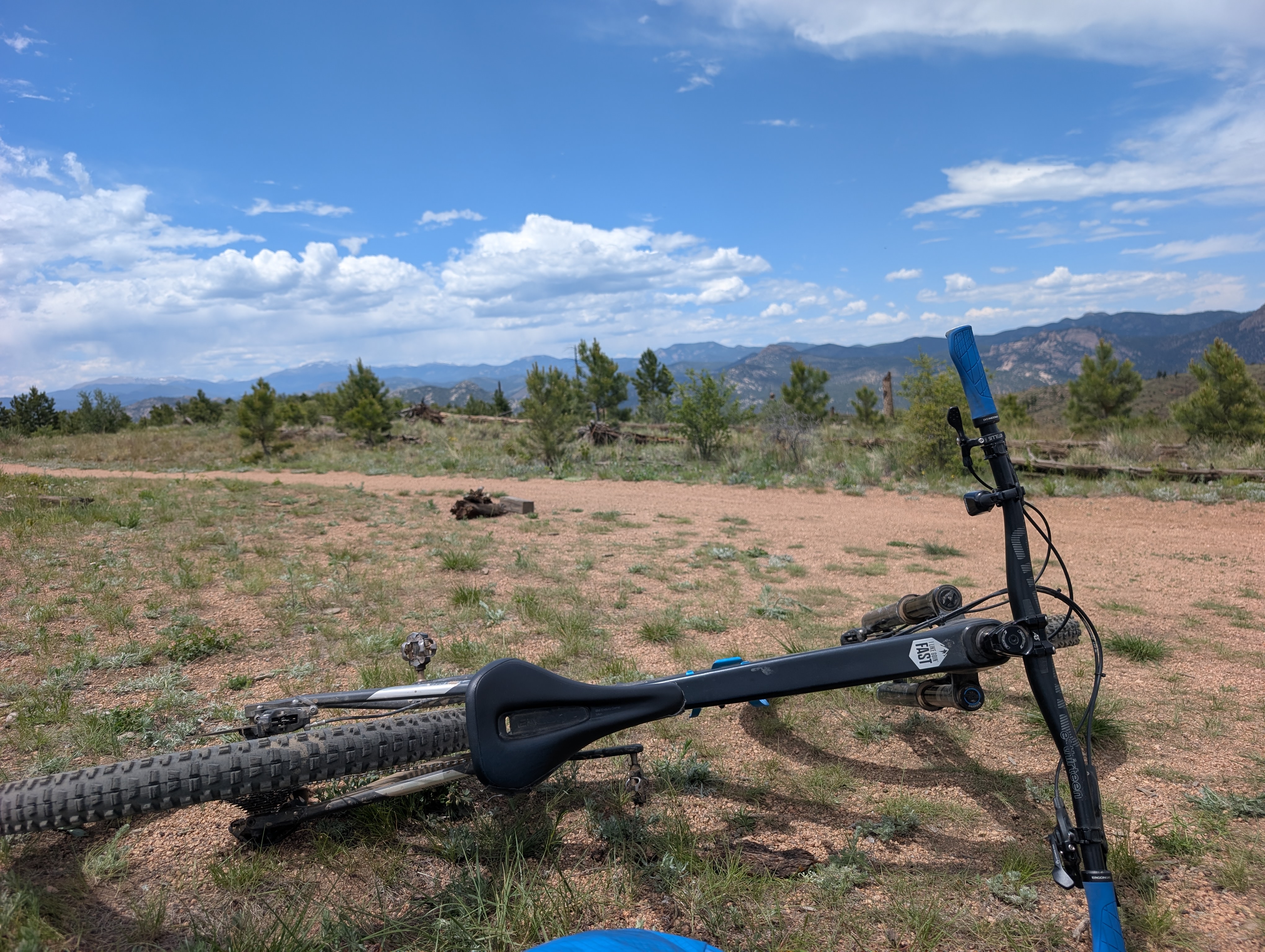
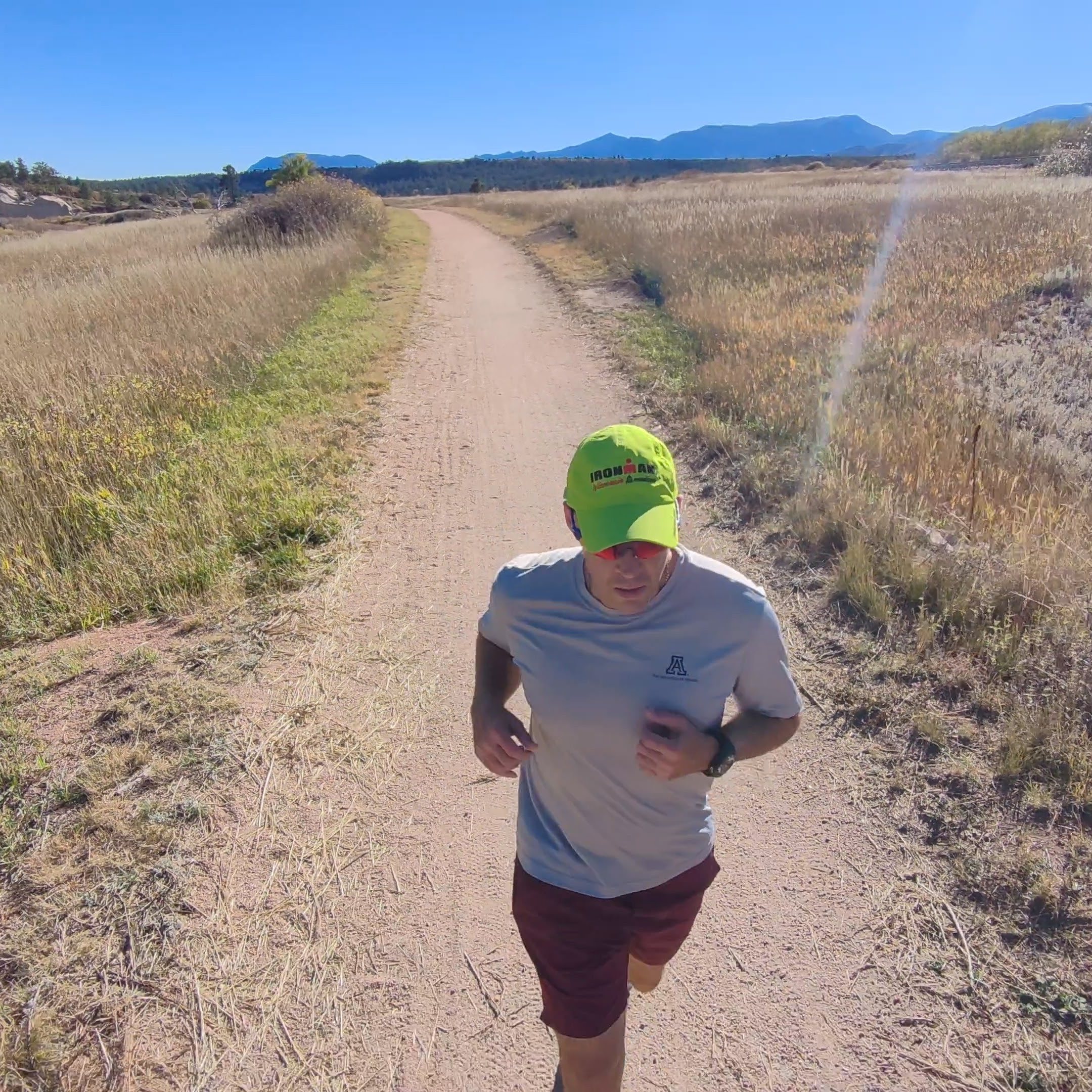




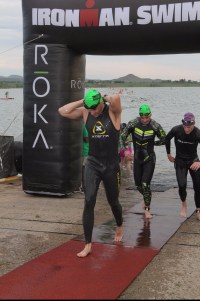 Easing into it, I gradually started to pick up the tempo half way down the first stretch. And I started passing a lot of folks. Come on now, didn’t we all just self seed? Why are you up here if you can’t keep up? Self seeding only works if everyone is honest about their swim abilities.
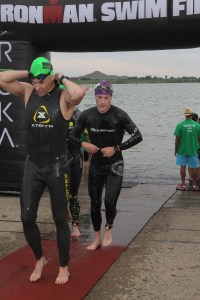 I kept up my tempo through the first half, checked my watch and took in the mountain views in the background. I could get used to this. I labored a little more on the second half, trying unsuccessfully to find feet to follow. Coming out of the water my watch read 1:02. Right about where I wanted to be.
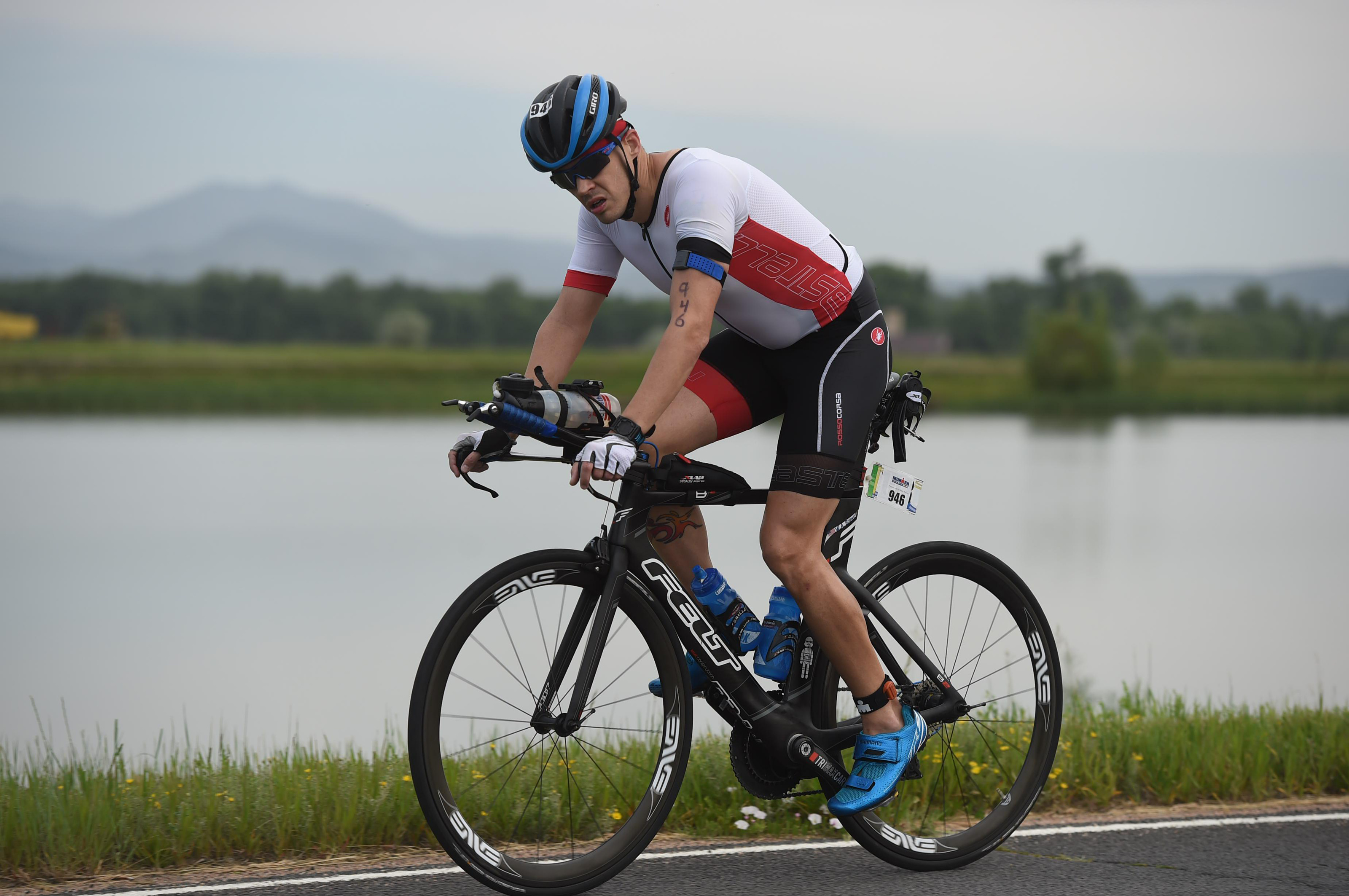
 I flew through the Reservoir transition area headed for lap 2. Turning back onto Jay Rd I passed a rider giving his bike a shower. Now I know people do this, but really folks why? None of us are getting paid, and are you really that fast that 90 seconds in the head is going to kill your race? Anyway, I started to pick up the pace steadily building into lap 2. I was crushing my own mental time stamps and my power and heart rate weren’t exploding. The legs continued to feel good. Finishing lap 2 cruising through the Reservoir I saw my father. Sitting up I gave him a big grin and shrugged my shoulders. Ain’t so bad! I continued to crush my early time estimates, keeping my pace up over 22 mph. I stayed areo for long glorious stretches taking in the mountain views and still the legs felt good, the effort under control. What altitude?
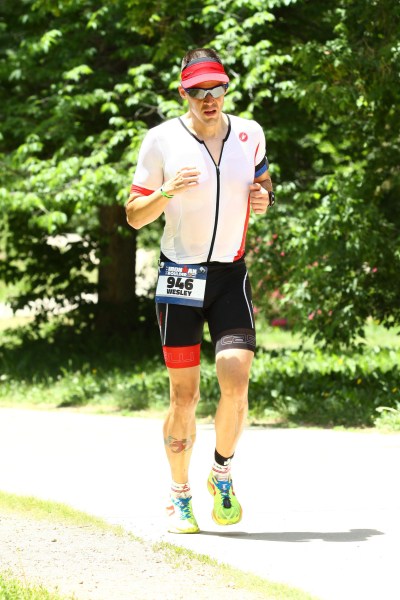 My mantra was short quick strides. “Quick, quick, quick,” I repeated over and over again. I got this. 9 minute miles gets me well under a sub 11 hour finish. I was executing beautifully. Visions of 10:45 danced in my head. I smiled. I can do this. At around the 10 mile mark I noticed my stomach starting to churn. A short time later, it was rocking the Floyd Mayweather combos on me from the inside. Nausea overtook me. I dropped from running to run/walking a 3min/2min ratio to maintain forward progress, hoping to get things under control. Then I just staggered. I could not stand the sight of solid food at the aid stations. I knew I needed it, but just looking at it made my stomach churn. Run/walking
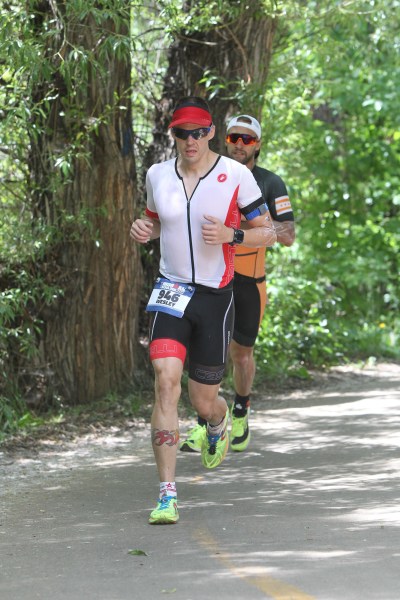 through 4 more miles before I spent some quality time in a port-a-jon. Twice. On that second lap I went into a real dark place for a couple of miles shuffling from aid station to aid station trying to find the right combination of food and drink to get moving again. Nothing was appealing. I saw Davita a couple of times on the run. She said later I looked like I was in rough shape. Around mile 20 I mentally came back into focus but my body was thrashed. At mile 21 Dave from Chicago came up alongside and said “come on, shuffle with me to the finish.” So we shuffled to the end together. I love this unspoken camaraderie that can be found at any Ironman race. Thanks Dave, I needed that!