
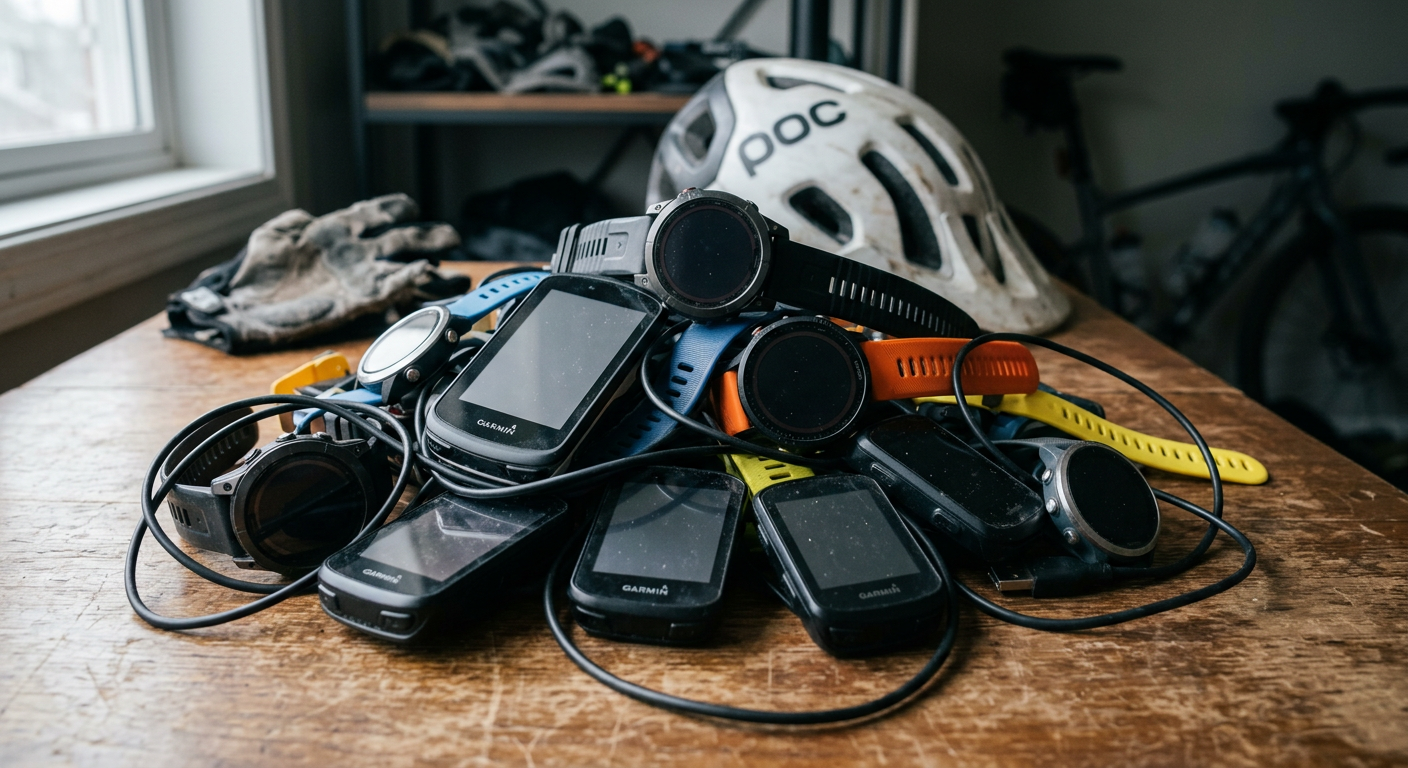
A few weeks ago I watched an athlete’s heart rate climb ten beats per minute on a climb she’d run a dozen times before, at a pace that felt, in her words, “exactly the same as always.” Her watch said she was working harder. Her legs said otherwise. Her watch was wrong.
That gap — between what your metrics say and what your body is actually telling you — is the whole reason I build every training plan around Rate of Perceived Exertion first, and heart rate, power, and pace second.
Not instead of them. Alongside them. But in the right order, because each of these tools is only honest under certain conditions, and none of them was built to run the whole show.
Heart rate: honest in the lab, unreliable everywhere else
Heart rate zone training came out of controlled lab tests in the 1970s and 80s — steady conditions, steady temperature, steady terrain. It’s a great tool in that exact environment. The problem is that almost none of you train in that environment.
Your heart rate isn’t just responding to your pace. It’s responding to your total stress load — and that includes things that have nothing to do with fitness:
- Heat. Your body diverts blood to your skin to cool you off, so your heart rate climbs at the same pace and same effort, just because it’s 85°F instead of 60°F.
- Elevation. Above about 5,000 feet, there’s less oxygen pressure in the air, so your heart works harder for the same output — before you’ve done anything differently.
- Hydration and caffeine. Both push heart rate up independent of effort.
- Cardiac drift. On a long ride or run, your heart rate climbs over time even when your effort hasn’t changed — partly rising core temperature, partly accumulating fatigue. If you chase a fixed heart rate number on a long day, cardiac drift will quietly talk you into slowing down when you don’t actually need to.
- Fatigue, going the other direction. A genuinely tired athlete’s heart rate response gets blunted — it climbs more slowly and tops out lower, which can trick you into thinking you’re not working hard when you’re actually cooked.
None of that means heart rate is useless. Your resting heart rate and your recovery heart rate — measured the same way, under similar conditions — are genuinely useful signals for how well you’re absorbing training. I still have athletes track both. I just don’t build a workout around hitting a heart rate number when the conditions that day make that number meaningless.
Power: excellent on a bike, still catching up everywhere else
This is where discipline matters most, so let me be direct instead of vague: if you’re on the bike, your power meter is one of the best tools available, full stop. Cycling is a closed mechanical system — the road or trainer doesn’t change shape under you the way trail does. A watt is a watt whether you’re fresh or fried, uphill or down, once you account for grade. I use power on the bike constantly, especially for structured intervals and pacing long rides.
Running power is a different story — not because the idea is bad, but because the technology isn’t there yet. Running power meters don’t actually measure force directly; they estimate it from your motion and back-calculate what it would take to produce that speed. That estimate holds up fine on a flat road or a familiar loop of consistent trail. It falls apart the moment the surface changes — pavement to sand, hardpack to loose scree, a technical descent versus a smooth fire road. For anyone training across mixed or technical terrain, which is most of you, running power is a data point to note, not a number to chase.
And in the water — there’s no meaningful power metric at all. Feel is genuinely the only real-time tool you have.
Pace: only honest on a track
Pace tells you what you did. It doesn’t tell you how hard it was to do it. A 9-minute mile on fresh legs, flat pavement, cool morning air is not the same event as a 9-minute mile at hour six of a long trail day, climbing, in the heat. Same number on your watch, completely different physiological reality.
Pace is still worth tracking — it’s how you measure progress over time on comparable terrain, and it’s useful for pacing strategy on a course you know well. But treated as the primary intensity signal, it actively misleads you the second the terrain, weather, or fatigue level changes. Which, if you’re training for adventure instead of a treadmill, is most of the time.
RPE: the only tool that’s actually watching all of it at once
Rate of Perceived Exertion is nothing fancier than a 1–10 scale of how hard something feels, developed by a Swedish researcher named Gunnar Borg back in the 1960s. It sounds almost too simple to trust. Here’s why it works better than it sounds like it should: it’s the only measurement that integrates cardiovascular strain, muscular fatigue, and whatever the day itself is throwing at you — heat, altitude, bad sleep, a stressful week at work — into a single real-time number. Heart rate, power, and pace each capture a slice of that picture. RPE captures the whole thing, because it’s coming from the one sensor that’s actually experiencing everything at once: you.
The catch is that RPE is subjective — my 6 might be your 8. That’s exactly why I don’t just hand an athlete a scale and hope for the best. I calibrate it, using something borrowed straight from exercise science called the Talk Test:
- Comfortable — you can talk in full sentences without effort. That’s roughly RPE 1–4.
- Labored — you can still talk, but only a sentence at a time before you need to catch your breath. That’s your threshold zone, RPE 5–7.
- Uncomfortable — you can barely speak at all. RPE 8–10.
Do that a few times across different efforts and I have a real, personal read on how you interpret hard — not a generic chart that assumes everyone feels intensity the same way.
How this actually shows up in your training plan
In practice, it looks like this:
- On the bike — power is my primary number for structured work, RPE confirms it still feels right on the day.
- On technical trail, in heat, or at altitude — RPE leads, heart rate is a secondary note, pace is context, not a target.
- In the water — RPE, essentially by default. There’s nothing else reliable to lean on. But coach, you chased the clock for decades in the pool. Yes I did. But we’re endurance athletes, we’re not chasing hundredths of a second here, we’re chasing hours. I’m not knocking master’s swim programs, they’re great. But we’re not training for a 200 fly at master’s nationals.
- On race day, especially anything with real climbing — I build pacing strategy RPE-first: figure out the effort you can sustain on the hardest climb, then hold everything else one to two points below that. That’s a more honest pacing plan than a flat heart rate or pace target that falls apart the moment the course tilts uphill.
None of this means throw away your devices. It means using them for what they’re actually good at, and not asking a heart rate monitor to do a job it was never built for. Data should inform your training. It shouldn’t be the verdict on how your day went — your body already knows that, if you’re paying attention to it.
Want help building a training plan that actually reads your effort instead of arguing with your watch?
Hit reply and tell me what you’re training for — or if you’re on Instagram, DM me RPE and I’ll walk you through exactly how I’d calibrate it for you.
Train for adventure. Let performance follow.
— Coach Wes

